TryShadowing
Shadow YouTube. Speak English.
Home
Browse
Dictation
NEW
My Library
en
0
days
Sign in
100 Most Common English Wor… — English with Lucy shadowing | TryShadowing
TryShadowing
Shadow YouTube. Speak English.
Home
Browse
Dictation
NEW
My Library
en
0
days
Sign in
Home
Browse
English with Lucy
100 Most Common English Words (Pronunciation & Example Sentence)
100 Most Common English Words (Pronunciation & Example Sentence)
English with Lucy
·
18:15 · Apr 21, 2022
Start Shadowing
0:00
0:00
Record
×1
1x
VI
EN
JA
KO
ZH
FR
PT
TH
IT
DE
IPA
Pronunciation scoring isn't supported on this browser — you can still record and listen back.
-
Hello
lovely
students.
Translating…
Turn on Record to capture your voice and get scored
Smart
Karaoke
Original
Line
1
/247
0:00
- Hello lovely students.
0:01
And welcome back to English with Lucy.
0:04
Big lesson today, big, big lesson.
0:08
Let's start today's class with a question.
0:12
I want you to guess how many words do you think there are in
0:16
the English language?
0:18
Don't Google it.
0:19
I will tell you the answer, well,
0:21
there have been various studies
0:22
and some of them say
0:24
that there are over 170,000 words in the English language.
0:29
That's a lot of words,
0:30
but on average a native English speaker will know between 15
0:35
and 20,000 words.
0:37
This is an insane amount of words.
0:40
I can't even count to 20,000, but don't despair.
0:44
It has claimed that the top 100 words in English make up 50% of
0:51
the language today.
0:53
I thought it would be an excellent idea to help you to perfect those
0:59
top 100 words in English.
1:01
Break this down into the different parts of speech.
1:04
I'll show you how to spell the words,
1:07
how to pronounce them in both their weak form and their strong form.
1:11
I'll also give you an example with the word in use.
1:16
It's a hugely important lesson and to make it even better,
1:20
I have created a PDF for you to use along with this lesson,
1:25
it contains everything we're going to study today.
1:27
All of the words along with their pronunciation and examples.
1:31
If you would like to download that,
1:33
just click on the link in the description box you enter your name
1:36
and your email address.
1:38
You sign up to my mailing list
1:39
and the PDF will arrive directly in your inbox.
1:42
After that you will automatically receive all of my free lesson PDFs along with
1:48
my news offers and course updates.
1:50
Don't miss out.
1:51
It's a big PDF today.
1:53
Let's get started with the first section of this video.
1:56
It's all about nouns.
1:58
And noun is a word that refers to a place, a person, an idea,
2:03
a thing, a quality or an activity.
2:06
Let's take a look at 10 of the most common nouns in the English
2:09
language.
2:09
And most importantly, their pronunciation.
2:12
First we have man, man.
2:16
The man sat quietly on the chair.
2:18
Day, day, it was the last day of summer.
2:24
People, people, many people travel abroad for their holiday.
2:30
Time, time, what time will they come to the house today?
2:36
Woman, woman.
2:41
He saw the woman from across the room.
2:46
Life, life, Jack spent his whole life writing his novel.
2:49
World, world, the world is a big place.
2:54
Go out and see it.
2:56
Thing, thing, we've both brought the same thing.
3:02
Year, year, this year has been the craziest yet.
3:11
Child, child, she was only a child
3:13
but she could play the piano better than anyone.
3:15
Now let's move on to pronouns.
3:18
A pronoun can substitute a noun or a noun phrase in a sentence.
3:23
We can only use a pronoun
3:25
if the noun or noun phrase has been referred to previously,
3:28
we have 20 to look at today
3:30
and they include both strong
3:32
and weak forms.
3:33
He or hi, he or hi, he likes to go out ice skating.
3:41
Her or her, her or her,
3:47
her shoes were left out in the rain all night.
3:50
Him or im, him or im, can you take him to the station please?
3:58
I, I, I am from England.
4:03
It, it, it looks as if she's been crying.
4:08
Me or mi, me or mi.
4:14
Don't give me that look.
4:15
My, my, my new phone should arrive today.
4:20
Our or our, our, or our,
4:27
our new home is in the village not far from here.
4:30
She or she, she or she, she is from a posh family.
4:36
What do you expect.
4:38
Them or them or them or them,
4:45
I went with them to see the play.
4:45
That or that, that, or that, that picture frame is crooked.
4:54
Their, their, their payments are overdue.
4:59
These, these, these flowers are beautiful.
5:05
They, they, they missed the train.
5:10
So they walked home instead.
5:12
This, this, this is the road I used to take to school
5:18
as a child.
5:19
Us or us, us or us.
5:25
We always bring a few snacks with us.
5:28
We or we, we or we,
5:33
we had just started hiking when Jerry hurt his knee.
5:37
Who, who, who was that in your office?
5:43
You or you.
5:45
You or you, you shouldn't do that.
5:51
You shouldn't do that.
5:52
Your or your, your or your, your sister came over yesterday looking for you.
6:01
Now let's move on to verbs.
6:03
Every sentence needs a verb.
6:05
And we use them to represent actions, feelings or states of being.
6:10
Come, come, come to my house tonight.
6:15
We're making pizza.
6:17
Find, find I can't find the remote control.
6:27
Give, give, can you give me a minute?
6:28
Get, get, I hope I get a raise this month.
6:34
Go, go, Sheila, go and speak with your father.
6:41
Have or have Have, or have, I have the forms in my bag.
6:54
Know, know, I know this can't be easy to hear.
6:55
Listen, listen, listen to his new song.
7:01
It's great.
7:03
Look, look, they will look at the sculpture for hours.
7:09
Make, make, what are you going to make for the school picnic?
7:16
Say say, don't say things that you don't mean.
7:23
See, see, I could see she was angry from her facial expression.
7:30
Tell, tell, tell him about it after his birthday.
7:36
Think, think, I always think about leaving my job.
7:44
Use use, can I use baking powder instead of baking soda?
7:51
Want, want, they want to take a cruise this year.
7:58
Now let's move on to auxiliary verbs.
8:01
These are incredibly useful in English.
8:03
They're also referred to as helping verbs or modal verbs.
8:08
They help to form certain verb tenses, voices and moods.
8:12
Let's take a look at them.
8:13
Be or bi, be or bi, I'll be swimming tomorrow morning.
8:22
Can or can, can or can,
8:29
Can you lift the chair up so I can sweep under it?
8:31
Could or could, could or could,
8:37
I could leave work early to pick up the wine.
8:40
Do or da, do or da, do they always come this late?
8:48
Shall or shall, shall or shall, I shall ask him tomorrow.
8:56
Might, might.
9:01
They might stay a little longer.
9:02
Must or must, must or must.
9:10
You must allow me to take you for dinner.
9:11
Should or should, should or should, I should really be going now.
9:18
Would or would, would or would, I would like a skateboard for Christmas.
9:27
Will or will, will or will.
9:32
We will write to you as soon as we arrive.
9:35
Next we're going to look at some adjectives.
9:37
Some very common adjectives.
9:39
Adjectives are used to describe nouns and they provide more detail.
9:44
All, all.
9:47
Did you put all of the food away?
9:49
Any, any, I don't have any patience for you right now.
9:55
Different, different, can you get me a different mug?
10:02
Even, even, he wants the painting to be even on the wall.
10:08
First, first, Ben was the first person to call me after my breakup.
10:17
Just, just, it wasn't just of him to treat you that way.
10:24
Last last, this is my last phone call.
10:30
White, white, when I opened my eyes, I saw white walls.
10:43
Many, many, we have too many boxes to move.
10:44
More, more, please could I have more potatoes?
10:51
New, new, her new shoes are black.
10:58
One, one, my dog has one blue eye and the other is brown.
11:06
Some or some, some or some.
11:13
Please could I borrow some money?
11:20
Two, two, the two trees in the garden need to be chopped down.
11:23
Now we're moving on to adverbs.
11:26
These are words that help you to describe an adjective, a verb,
11:30
another adverb or even an entire sentence.
11:33
You may have learned that most ad verbs end in LY.
11:37
And this is true,
11:39
but you will be surprised at some of the most common ones.
11:42
Let's take a look.
11:43
Also, also, we also live up the hill.
11:49
Here, here, I live here too.
11:55
How, how, he didn't know how to speak Italian.
12:01
No, no, call no later than 7:00 PM.
12:08
Not, not, it is not snowing today.
12:13
So, so, she was so early for the party.
12:20
Then, then, we can't go back to how it was then.
12:26
Very, very, Dave was very angry after the meeting.
12:37
When, when, when will you be leaving?
12:38
Now we have some conjunctions and these are really key.
12:43
They allow us to join multiple phrases and sentences together.
12:48
Without conjunctions, reading would be really boring.
12:51
Let's get started, and or and.
12:56
And or and clean your room and the bathroom.
13:01
Because or because, because or because,
13:07
I can't come tonight because I have work in the morning.
13:11
But or but, but or but,
13:18
they don't have a size three but they do have a size four.
13:22
If, if, she will cover for me, if I stay late tomorrow.
13:28
Or, or, we can get Chinese or Indian food, it's up to you.
13:36
Than or than, than or than.
13:42
I'd rather stay at home than go to a nightclub.
13:46
Next we have prepositions.
13:48
These are really important.
13:49
They show you how one part of sentence is related to another.
13:53
About, about, I'll be there in about five minutes.
14:00
At or at, at or at.
14:07
Turn right at the end of the street.
14:09
By, by, my purse is by the dining room chair.
14:16
For or for, for or for, is all of that for you?
14:25
From or from, from or from, that present is from all of us.
14:34
In, in, just put it in the box.
14:40
Into or into, into or into.
14:48
Put it into the fridge, not the oven.
14:50
On, on, the book is on the shelf.
14:56
To or to to or to, we're going to the fair today.
15:04
With, with don't leave me with him.
15:10
Finally have articles.
15:12
There are only three in English.
15:14
So I bet you can guess which ones I've included.
15:16
We have a, or a, a or a,
15:23
a man came to see you today.
15:24
We have an, or an, an or an,
15:31
is that an orange on the sofa?
15:32
And finally, number 100, we have the or the, the or the,
15:42
the new table looks wonderful.
15:44
Right, there you have it,
15:45
100 of the most common words in the English language.
15:48
The words that comprise the majority of open and written English,
15:53
that was a lot today.
15:54
So I highly recommend that you download the PDF that we've created for you.
15:59
It's got everything and some additional information.
16:01
If you'd like to do that,
16:03
just click on the link in the description box,
16:05
you enter your name and your email address.
16:07
You sign up to my mailing list
16:09
and the PDF will arrive directly in your inbox.
16:12
Don't forget to connect with me on all of my social media.
16:15
I've got my Instagram page, EnglishwithLucy.
16:18
I've got my personal Instagram, just @Lucy.
16:21
I've got my TikTok page, and I've got my website Englishwithlucy.co.uk.
16:24
If you are interested in pronunciation,
16:24
then I have a fantastic pronunciation tool on my website.
16:24
You can click on all the different phonemes
16:24
and you can hear me pronounce those phonemes
16:24
and words containing those phonemes.
16:24
It's a really good way to familiarise yourself with phonetic transcriptions
16:25
and the different sounds
16:25
that comprise modern RP.
16:25
If you'd like to improve your vocabulary and your listening skills,
16:25
then I also have my vlogging channel,
16:25
where I document my life here in the English countryside.
16:25
All of the vlogs are fully subtitled
16:25
so you can use them to practise with,
16:25
I will see you soon for another lesson.
16:25
Bye, so there are 100 of these.
16:25
This is gonna be a long video.
16:25
Child, she was only a child but she could play the.
16:25
And we use them to represent actions, feelings or what.
16:25
Ooh, okay.
16:25
We are just. (watch chiming) This is ironic.
16:25
My watch has told me to take a mindful moment by disturbing my work.
16:25
Thanks, Apple, bastard.
16:25
These sentences are so random. (gentle music)
Like
Share
English with Lucy
View all →
B1
English lessons
Karaoke
20:12
ONE language, THREE accents - UK vs. USA vs. AUS English! (+ Free PDF)
English with Lucy
4
B1
English lessons
Karaoke
8:51
DO NOT say "you're welcome"! Respond to "thank you" PROPERLY!
English with Lucy
B1
English lessons
16:36
SELF INTRODUCTION | How to Introduce Yourself in English | Tell Me About Yourself Interview Answer
English with Lucy
B1
English lessons
Karaoke
12:51
20 Different Ways To Wish ‘Happy Birthday’ & 'Happy Anniversary' (+ Free PDF & Quiz)
English with Lucy
B1
English lessons
Karaoke
10:21
5 things to practice every day to improve your English communication skills
English with Lucy
B1
English lessons
Karaoke
29:52
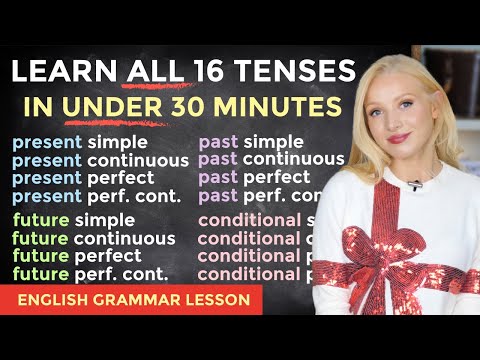
Learn ALL 16 TENSES Easily in under 30 Minutes - Present, Past, Future, Conditional +Free PDF & Quiz
English with Lucy
B1
English lessons
11:18
DO NOT say "how are you?"! Ask the question in a better way!
English with Lucy
B1
English lessons
Karaoke
9:08
You are absolutely fluent in English if you can understand these
English with Lucy
Suggested videos
B1
English lessons
Karaoke
20:12
ONE language, THREE accents - UK vs. USA vs. AUS English! (+ Free PDF)
English with Lucy
4
B1
English lessons
Karaoke
8:51
DO NOT say "you're welcome"! Respond to "thank you" PROPERLY!
English with Lucy
B1
English lessons
16:36
SELF INTRODUCTION | How to Introduce Yourself in English | Tell Me About Yourself Interview Answer
English with Lucy
B1
English lessons
Karaoke
12:51
20 Different Ways To Wish ‘Happy Birthday’ & 'Happy Anniversary' (+ Free PDF & Quiz)
English with Lucy
B1
English lessons
Karaoke
10:21
5 things to practice every day to improve your English communication skills
English with Lucy
B1
English lessons
Karaoke
29:52
Learn ALL 16 TENSES Easily in under 30 Minutes - Present, Past, Future, Conditional +Free PDF & Quiz
English with Lucy
B1
English lessons
11:18
DO NOT say "how are you?"! Ask the question in a better way!
English with Lucy
B1
English lessons
Karaoke
9:08
You are absolutely fluent in English if you can understand these
English with Lucy