TryShadowing
Shadow YouTube. Speak English.
Home
Browse
Dictation
NEW
My Library
en
0
days
Sign in
Breathtaking Wildlife Worlds - Narr… — BBC Earth shadowing | TryShadowing
TryShadowing
Shadow YouTube. Speak English.
Home
Browse
Dictation
NEW
My Library
en
0
days
Sign in
Home
Browse
BBC Earth
Breathtaking Wildlife Worlds - Narrated by David Attenborough | BBC Earth
Breathtaking Wildlife Worlds - Narrated by David Attenborough | BBC Earth
BBC Earth
·
2:59:55 · Apr 17, 2026
Start Shadowing
0:00
0:00
Record
×1
1x
VI
EN
JA
KO
ZH
FR
PT
TH
IT
DE
IPA
Pronunciation scoring isn't supported on this browser — you can still record and listen back.
And
now
the
snakes
are
on
the
alert.
Translating…
Turn on Record to capture your voice and get scored
Smart
Karaoke
Line
1
/1155
0:05
And now the snakes are on the alert.
0:09
This is the best feeding opportunity they will get all year.
0:29
On flat ground, a baby iguana can outrun a racer snake.
0:35
But others are waiting in ambush.
1:05
Another hatchling has its first glimpse of a dangerous world.
2:07
>> A snake's eyes aren't very good.
2:10
But they can detect movement.
2:14
So, if the hatchling keeps its nerve, it may just avoid detection.
3:51
A near miraculous escape.
4:00
The lucky survivors could begin learning the unique way of life demanded by this
4:05
hostile island.
4:09
Wolves.
4:09
These in northern Canada are the largest and most powerful in the world,
4:13
and they're setting out to hunt.
4:20
The pack is 25 strong, a sign that the prey they're seeking is formidable.
4:34
These bison are even bigger than their southern cousins
4:37
and the largest land animals in North America.
4:41
For generations, wolves and bison here have been shaped by their battles with each
4:46
other,
4:47
making each the most impressive of its kind.
4:52
The bison will not stay long among the trees.
4:56
They're not safe here.
5:04
>> >> The wolves are closing in,
5:06
but their chance of ambushing the bison in the woods has passed.
5:09
Their prey are now in the open and grouped together for safety.
5:17
The wolves will need to work
5:18
as a team if they're to make a kill.
5:24
They circle the herd trying to unsettle it and split it up.
5:29
But the bison are armed and dangerous.
5:31
They will be safe as long as they stick together.
5:40
The wolves up their game harrying the herd,
5:42
a ploy to trigger a stampede and split away one of the smaller ones.
5:49
The bison form a defensive circle around their young, horns pointing outwards.
6:01
The wolves need a bison to break rank.
6:10
But the tables are turning and now the wolves have to retreat.
6:17
The pack focus their attention on the rear of the herd
6:20
and the bison begin to panic.
6:57
>> >> A young bison falls behind.
7:05
>> >> Even this yearling dwarfs the wolves.
7:16
Running head down, the herd's only thought is escape.
7:25
A stroke of luck for the wolves.
7:40
The kill will feed the pack for several days.
7:44
But then, they will have to resume the chase.
7:48
Their cover blown, escape seems impossible.
8:03
But these particular fish have a unique ability.
8:21
>> >> They are flying fish.
8:45
>> >> With an extra thrust from their tails, the flying fish get airborne once more.
8:59
With a good wind, they can glide for hundreds of meters.
9:20
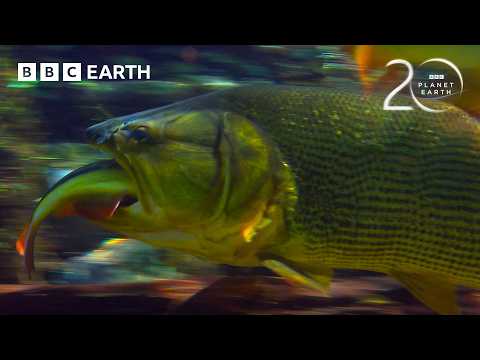
>> >> But this is just what the frigate birds have been waiting for.
9:28
When frigates join the hunt,
9:30
the flying fish are literally caught between the devil and the deep blue sea.
9:58
If the flying fish get too much lift,
10:00
they become easy prey for the frigate.
10:18
>> >> If they dive to evade attacks from above,
10:25
they could fall into the mouths of the dorado.
11:01
>> >> Mantis will eat anything that moves, including other mantis.
11:23
Time to leave.
11:36
>> This tiny insect is now open to attack from predators lurking in the undergrowth.
11:52
Whether an individual mantis survives or not is partly a matter of chance.
12:01
Whether it's spotted by a predator.
12:10
Whether it turns right or left.
12:23
So far, it's luck has held.
12:27
But this hungry jumping spider is still in pursuit.
12:36
A mantis is born with exceptional eyesight.
12:41
But the spider's is even better.
12:48
Although this young mantis can't yet fly,
12:51
its long forelegs evolved to catch prey give it reach.
13:23
There seems to be no escape.
13:33
But this mantis has a surprising line in self-defense.
13:39
Kung fu, praying mantis style.
13:55
Of course, it's all bluff.
13:57
Trying to look bigger and confuse its enemy.
14:04
But it's got away with it.
14:14
Just staying alive for its first few hours is a significant accomplishment for a
14:20
newly hatched insect.
14:23
But there's still a long way to go.
14:26
With a bit of luck, in two months time,
14:29
it'll be as big and beautiful as this orchid mantid.
14:45
Or maybe not.
14:48
After all, mantids are cannibals.
14:55
However, there are plenty more where that one came from.
15:01
At this time of year,
15:03
polar bears on average succeed only once in 20 hunts.
15:13
If the hunter is skinny, like this one, that may not be often enough.
15:26
>> All she can do is keep trying.
16:07
>> >> To prevent her scent betraying her,
16:10
she makes a wide sweep to get downwind of the seal.
16:26
Getting close.
16:50
She's now right behind the seal.
17:36
>> Incredibly, she caught the seal underwater.
17:45
It's only small, but even so, it's blubber alone will contain 100,000 calories,
17:52
enough to sustain this bear for a week.
18:06
And in that time, she might even catch another.
18:18
But this can't go on forever.
18:21
As summer continues, temperatures are rising.
18:25
Each hunt requires more energy, draining the bears of their reserves.
18:36
Kenya, famous for its big cats, the supreme hunters.
18:55
Cheetahs specialize in hunting at speed.
18:58
Though fast, they're fragile creatures built to sprint after small prey.
19:05
They don't have the strength
19:06
or weight of a lion to bring down larger animals.
19:12
This male is different.
19:14
He doesn't hunt alone.
19:15
He's learned that there is strength in numbers.
19:32
But here, there are not just two, but three cheetahs.
19:37
A band of brothers.
19:46
They have changed their tactics, and by doing so,
19:49
have taken their prey by surprise.
19:53
They have learned that working together, they can bring down large prey.
20:03
An ostrich.
20:05
A bird that towers over a cheetah and is more than twice as heavy.
20:11
It can't fly to escape danger,
20:13
but it can lash out with a deadly kick.
20:17
A female, unaware as yet of any danger.
20:27
Even with three of them, this is still highly risky.
20:31
If one gets injured, the other two couldn't hope to tackle such large prey.
20:44
On the other hand, if they get it right, the rewards are huge.
20:57
The male has spotted one of the brothers, but only one.
21:02
It's not too worried.
21:16
>> Then suddenly there are three.
21:30
The female is slower to realize the danger and the cheetahs switch targets.
22:00
It takes the combined effort
22:02
and weight of all three brothers to bring down this powerful bird.
22:07
Even now the ostrich could land a fatal kick.
22:18
So far the brothers are winning.
22:20
Ostriches have yet to find a way to foil such tactics.
22:25
Food is so hard to find this far north
22:28
that a wolf pack must search hundreds of square kilometers
22:32
if it's to be successful.
22:35
And success means raising the next generation.
22:44
To do that here, the wolves must work together.
22:51
So the young are raised not only by their parents,
22:54
but by their aunts and uncles as well.
23:02
Together they try to ensure
23:04
that each pup reaches near adult size before the snow returns.
23:13
A growing pup needs more than just a few lemmings.
23:18
The wolves need bigger prey, and to catch that,
23:24
they must hunt as a pack.
23:48
Adult hares may be easy to spot, but they're far from easy to catch.
23:55
They run at 60 km an hour.
24:03
To catch one, the wolves work as a team.
24:48
>> >> One of them gets close enough to bite the hare's tail,
24:56
but a hare can change direction in an instant.
25:08
If it can continue to sidestep and it may ultimately outlast them.
25:26
Finally, it gets away.
25:42
For the next hare, the whole pack gives chase.
26:01
>> >> Now, numbers count.
26:05
The lead wolves keep up the pace.
26:07
Others run on either side so the hare can't change direction.
26:18
A tiny meal for the whole pack.
26:21
Even when more sea lions arrive,
26:24
they can't seem to break down the sardines' coordinated defenses.
26:46
With a shoal this big, the sea lions need to isolate a smaller,
26:50
more manageable group of fish.
26:58
But, with so few predators, the fish still have the advantage.
27:07
All the sea lions can do is keep the sardines at the surface
27:12
and wait for others to join them.
27:26
Tuna.
27:26
Their arrival changes everything.
27:41
Tuna attack from below, cutting off the sardines escape route down to deeper water.
27:56
Next to appear, shearwaters.
27:59
Excellent flyers, but also surprisingly agile underwater.
28:07
With so many predators attacking from all sides,
28:11
the advantage starts to shift away from the sardines.
28:35
>> >> As the fish pack ever tighter,
28:37
their shoaling strategy now makes it easier for the hunters.
29:06
>> >> Copper sharks.
29:08
They've scented blood in the water.
29:17
Surprisingly perhaps, the predators never attack one another.
29:21
They work together to corral the ball of fish,
29:24
taking turns to grab a mouthful.
29:36
Common dolphins.
29:41
As the shoal gets ever smaller,
29:43
each sardine scrambles desperately to hide in the middle.
29:48
But now, there's no escape.
30:09
>> >> A Bryde's whale finishes off the feast.
30:14
Tons of sardines devoured in less than an hour.
30:21
During the dry season,
30:23
over half a million terns crowd onto this remote atoll in the Indian Ocean.
30:36
Their chicks are still in their dark juvenile plumage.
30:45
>> They vary in age.
30:55
Whilst the more advanced chicks take to the air, others aren't quite ready yet.
31:28
>> >> Those just starting to learn to fly use the shallow lagoon
31:32
that occupies the center of the atoll
31:35
as their training ground.
31:39
It's difficult for some of them to stay aloft for long.
32:06
Giant trevallies.
32:21
Usually, they are solitary hunters,
32:25
but about 50 of them have come here from neighboring reefs attracted by this
32:29
abundance of potential prey.
32:40
>> The fledglings stay out of the water if they can.
32:45
They even drink on the wing.
33:05
If the trevally are to catch one now, they have to up their game.
33:20
So, there is a fish here that, amazingly,
33:23
has a brain capable of calculating the air speed, altitude,
33:28
and trajectory of a bird.
34:02
The time comes when every fledgling has to take to the air
34:06
and collect food for itself.
34:32
Their parents lead them to the training grounds.
36:10
>> >> If they are to survive, they must learn quickly.
36:23
After a month of practicing over the lagoon,
36:26
the youngsters start to leave and take their chances out over the open sea.
36:31
But leopards are the most versatile of all the big cats,
36:36
adept at finding cover in the most unpromising places.
36:57
The steep walls of the gully are now her cover for an ambush.
37:07
The male puku is close enough, but he's too big to tackle.
37:13
She needs to slip past him without being seen.
37:28
If he spots her, he'll blow her cover.
37:50
Slowly does it.
38:00
To succeed here, she needs to find prey grazing close to the edge
38:06
or better still,
38:08
in the gully itself.
39:00
>> Frustration.
39:00
Success would have staved off hunger for a week.
39:07
But while there's prey around, there's hope.
39:14
Peeking over the top is a risk,
39:17
but it's the quickest way to find a new target.
39:56
A burst of speed of 65 km an hour
39:59
and it's all over in less than 6 seconds.
40:13
Except it isn't.
40:22
>> Dazed and disorientated, the impala makes a miraculous escape.
40:29
The Namib desert, one of the most exposed places on Earth.
40:40
As the sun climbs high, everybody takes cover from the extreme heat.
40:49
Everybody except the hot rod ant.
40:59
As others take refuge, their day is just beginning.
41:07
Cleaning out the nest.
41:15
The sun can reach a scorching 70°C.
41:21
The ants' long legs raise their bodies above the surface, where it's 10° cooler.
41:30
But if they stand still, they will fry.
41:36
They must keep moving or risk the same fate as their quarry,
41:40
the creatures that have collapsed from heatstroke.
41:44
Too deeply buried, but a good place to cool off.
41:51
Foraging decisions must be fast.
41:54
Too big?
42:02
Perfect.
42:02
Back to the nest before they also die.
42:12
But they've strayed a minefield.
42:20
Each of these strange cone-shaped pits is a death trap with a brutal predator
42:32
at its center.
42:35
Here lie antlion larvae, tiny ambush predators with venom-filled pincers.
43:04
Some ants manage to escape, but the antlion has other tricks.
43:10
Flinging sand into the air, it creates an avalanche.
43:19
In this cone of death,
43:21
the walls are so angled that the sand slips beneath the ants' feet.
43:29
As boulders rain from the sky, escape seems almost impossible.
44:21
>> >> Phew.
44:21
>> Not much remains of the porpoise after the whales are through with it.
44:30
Killer whales don't just target prey smaller than themselves.
44:36
Off the coast of California,
44:38
a gray whale and her baby are in serious danger.
44:49
Once again, computer images give the underwater view of an extraordinary hunt.
44:56
The gray whale calf is just a few weeks old.
44:59
It's following its mother north towards the summer feeding grounds in Alaska.
45:05
They've reached Monterey Bay, where a deep trench cuts in from the sea.
45:15
As they move beyond the trench wall, the gray whales lose their cover.
45:22
Out in the bay, the killer whales are listening for that telltale sound,
45:27
the breathing of a gray whale.
45:36
Immediately, their behavior changes.
45:38
The killers close ranks like a hunting wolf pack.
45:53
The killer whales have caught up with the mother and calf.
45:57
And now, the chase is on.
46:03
The gray whales try to outswim their attackers.
46:09
Fast swimming pushes up the grey whales breathing rate.
46:13
A breathless calf is easier to catch.
46:17
The killers work as a team.
46:20
Their first goal is to separate the baby from its mother.
46:27
>> >> The grey whale mother is a formidable adversary.
46:31
She could seriously harm a killer whale with just one slap of her massive
46:35
tail fluke.
46:46
One of the attackers pushes between mother and calf.
47:10
>> >> The strategy is working.
47:13
The grey whales are forced apart.
47:20
With the baby separated, the killer whales change strategy.
47:24
Now their goal is to drown the calf.
47:36
>> >> For sea lions to venture into deep water here is very dangerous indeed.
47:41
It's much safer to stay in the shallows if they can.
48:13
>> In one or two places,
48:15
>> >> channels enable the whales to get really close to the beach.
48:19
Those are the dangerous spots.
48:49
To get off the beach, the killer has to thrash its body.
48:58
No other whale deliberately beaches itself in this way
49:02
or has perfected this method of getting back to the sea.
49:22
As long as the sea lions stay well up the beach,
49:25
you might think they would be safe.
49:27
But the hungry whales are very daring.
49:44
Now, several of the whales are hunting in a group.
50:08
>> That sea lion was keeping just ahead of one of the whales,
50:11
but was caught by another it probably hadn't seen.
51:21
This is savage beating maybe to separate hide from flesh.
51:30
>> The army ant.
51:35
This may look like a ball of a million individuals, but make no mistake.
51:42
The colony acts as one.
51:46
A super organism with a sensory system of 2 million antennae.
51:54
A skeleton made from the living bodies of workers.
52:02
A defense system of soldier ants ready to act at any sign of danger.
52:11
A digestive system processing piles of food deep inside.
52:18
Even a coordinated system for dealing with all the waste.
52:26
These are insects that by working together transcend individual size.
52:35
The colony can search the entire jungle and flush out its wildlife.
52:49
Each day it sends out a silent probe into the forest in quest of
52:54
food.
53:03
It doesn't use scouts like other ants.
53:09
Instead, a vast search party pushes into virgin territory seeking out the signs of
53:21
anything alive.
53:35
They spread out along a 10-m front sweeping across the forest floor.
53:43
To find prey, the ants must first touch it.
53:48
The irony is that this,
53:50
the most successful hide-and-seek player in the forest, is almost completely blind.
53:58
It distinguishes the living only by their movement.
54:06
As long as an animal remains still, it is safe.
54:13
But the slightest twitch will give it away.
54:21
>> >> Within seconds, the prey is pinned down.
54:27
Within minutes, it's torn apart at its joints.
54:34
The more the prey struggles, the more the ants engage.
54:43
Right across the raid front,
54:46
prey of all sizes are driven from their hiding places.
54:53
Even wasps must abandon their homes when the ants arrive.
55:03
Everything alive in the path of the raiders overwhelmed by sheer numbers.
55:13
It's called Darwin's bark spider, and the female has a remarkable strategy.
55:38
>> >> Like a real-life spider woman,
55:41
she sprays strands of silk in one long continuous flow.
55:50
The threads fan out like a sail
55:52
and drift on air currents blowing across the water.
55:57
Every few seconds, she crimps the strands together to stop them spreading too widely.
56:05
The breeze will do the rest,
56:07
blowing the threads into a single line and a 25-m bridge.
56:16
Now, she must reinforce her bridge because her web will hang from it.
56:26
But, there's something bouncing the line at the other end.
56:31
Another Darwin spider is trying to take advantage of her hard work.
56:42
She must deal with the intruder head-on.
56:49
The cut line is an inconvenience, but no more than that.
56:56
With hooks on the tips of each leg, she gathers in the thread.
57:05
It won't go to waste as she'll eat it later.
57:16
When it's all reeled in, she sprays again.
57:23
Out streams another 25-m bridging line.
57:35
>> How a spider no bigger than a thumbnail can produce
57:38
so much silk so quickly has baffled scientists.
57:46
And it's no ordinary silk.
57:48
It's the toughest natural fiber on the planet, tougher than steel.
57:55
And it needs to be tough to span the wide river.
58:02
With the bridge taut and the ground anchor in place,
58:06
it's time to construct her trap.
58:21
These spiders can build the world's largest orb webs, up to 2 m wide.
58:30
A few hours from the first spray of bridging line, the job is done.
58:39
Now her strategy is simple.
58:43
Sit and wait.
59:04
>> >> And there's one final bout of silk production.
59:09
Shrink wrapping her food for later.
59:15
A Sally Lightfoot crab,
59:20
one of thousands of shore crabs just waiting for their moment.
59:28
Every day they gather on the tropical shores of Brazil.
59:35
Waiting for the tide to go out.
59:46
Which exposes their feeding grounds.
59:50
Seaweed covered rocks 100 m from the shore.
60:04
Getting there is a race against the tide.
60:14
They leap from rock to rock.
60:30
These crabs seem to be afraid of the water.
60:46
And for good reason.
61:00
The moray eel.
61:04
The chain moray is a specialist crab hunter.
61:13
Its blunt teeth can easily grip and crush a crab shell.
61:23
It's the crab's deadliest enemy.
61:37
But the crab's feeding grounds are still a long way off.
61:47
They must press on.
62:18
Halfway.
62:18
But their enemy has other ideas.
62:26
Crossing the land to reset the ambush.
62:40
To feed, the crabs must keep going.
62:50
But nowhere is safe.
62:56
An octopus, also a crab killer.
63:24
>> The crabs make a dash for it.
63:54
>> >> Made it.
64:04
>> >> Risking life and limb to graze on these seaweed pastures.
64:12
But in 2 hours time, when the tide starts to turn,
64:17
they will have to run the gauntlet over again.
64:35
It's July in the deserts of Nevada in the western United States.
64:41
The hottest time of the year.
64:57
Bands of wild horses, mustang,
65:00
are converging on one of the last remaining water holes around.
65:10
Now, water not only offers them the chance to drink,
65:14
it can also bring power.
65:19
If a stallion can control access to water,
65:22
he will have secured mating rights to the entire herd.
65:27
So, stallions try to dominate these pools, fighting off rivals who venture too close.
65:46
A stranger.
65:49
He's traveled 15 km to be here
65:52
because the pools where he's come from have already dried up.
65:59
With him come his females.
66:03
If he can't provide them with water,
66:05
they will leave him for the white stallion who already dominates this pool.
66:21
So, he will have to fight.
67:23
>> >> There is everything to lose.
67:27
A broken leg or a shattered jaw would mean a slow and painful death.
67:52
>> >> A missed kick and it's all over.
67:58
The new arrival has won.
68:02
And his prize is more than just a chance to drink.
68:06
He has provided for his herd and in the process stolen his rival's females.
68:14
>> >> The white stallion's rule is over.
68:33
>> >> These males are the troop leaders.
68:37
They hold all the power here.
68:49
Joining them is every young male's ambition.
68:57
To be accepted into this elite is the path to privilege,
69:02
but it's a dangerous journey.
69:21
The youngster decides to follow.
69:25
At first, he has enough sense to keep his distance.
69:30
These males are twice his size.
69:43
The low-ranking chimps retreat before the troop leaders arrive at the water hole.
69:57
Dominant males have a highly stressful life
70:00
as they constantly squabble to protect their position.
70:08
The youngster can't take his eyes off them.
70:22
>> >> This is his chance to get himself noticed.
70:27
If he can impress even one of the big males with a show of
70:30
strength,
70:30
he might just be accepted into their ranks.
70:46
>> >> His best attempt at a macho display has certainly caught their attention.
70:57
>> >> But they are not impressed.
71:09
>> >> In fact, this drumming means they're getting rather angry.
71:18
AND THEY ATTACK.
71:25
THE YOUNGSTER IS NOT QUICK ENOUGH.
71:37
>> >> HE GETS A SHORT,
71:38
SHARP LESSON about how hard it can be to break into this close-knit gang.
71:47
He's lucky to escape with just an injured hand.
72:00
>> >> For the moment, he's neither big enough nor strong enough to be
72:03
taken seriously by the troop leaders.
72:10
Without status, he will never enjoy the privileges of the best food
72:15
or the attention of females.
72:19
Losing its fear of humans has enabled one animal to spread into cities everywhere
72:25
and in huge numbers.
72:34
Pigeons are by far the most successful urban bird.
72:45
Here in Albi in the south of France,
72:48
the pigeons come to the river to bathe.
72:51
They need to preen their flight feathers, clean off the city dust,
72:56
and cool themselves down.
73:19
But death lies in wait.
73:23
A predator that has taken advantage of the very thing
73:26
that has led to the pigeon's success.
73:31
Their lack of fear.
73:36
As the pigeons bathe, oil from their plumage flows downstream and is detected.
73:52
A monstrous Wells catfish.
73:58
Introduced here just 40 years ago, they have proliferated,
74:05
virtually exterminated the local fish stocks, and they've now developed a taste for pigeon.
74:16
Their eyesight is poor,
74:18
so they use their barbels to sense the movements of their victims.
75:17
>> This is a radical new hunting strategy for what is normally a bottom-dwelling
75:22
fish.
75:38
After a thousand years of living in this city,
75:42
pigeons are now having to learn to avoid a fish.
75:50
A lone Grevy's zebra.
75:55
He weighs close to half a ton
75:58
and could go for 3 days without drinking.
76:06
Like the macaques, his forebears were refugees from the advancing Sahara.
76:17
The land is scrubby and dry,
76:24
but this stallion has claimed it as his own.
76:30
He's been waiting months for visitors.
76:34
Female visitors.
76:44
If they like his territory, they might stay a while.
76:52
It's his first chance to mate for a very long time.
77:10
Hardly a success.
77:14
Perhaps his visitors are looking for a more impressive partner.
77:21
>> >> There's another setback.
77:25
The females were being followed.
77:27
A posse of young males.
77:29
Everyone a rival.
77:37
It's time to separate the men from the boys.
78:06
>> >> One by one, the stallion sees them off.
78:33
The females had ringside seats.
78:38
And his prowess has not gone unnoted.
78:48
Machismo gives way to tenderness.
79:08
>> >> Around here, you have to take every opportunity.
79:12
Be it for food, for water, or for mates.
79:26
Female grevys are a fickle bunch.
79:30
The herd have decided to move on.
79:34
All of them.
79:37
The stallion may never see them again.
79:40
But there's a chance that one is now carrying his foal.
79:51
In a far corner of Southeast Asia lies the Coral Triangle.
80:00
A cluster of the richest coral reefs in the world.
80:09
Undersea cities crammed full of life.
80:20
As in any crowded metropolis, there is fierce rivalry for space, for food,
80:36
And for a partner.
80:39
But the reef is also a place full of opportunity.
80:57
>> >> A cuttlefish.
81:14
It specializes in hunting crabs.
81:27
But a large crab is a dangerous quarry.
81:38
It has powerful claws.
81:44
The cuttlefish, however, has a remarkable talent.
81:53
Its skin contains millions of pigment cells with
81:57
which it can create ever-changing colors
81:59
and patterns.
82:10
And that, apparently, hypnotizes the crab.
82:36
>> >> A cuttlefish may be clever, but a shark is bigger.
82:43
And it eats cuttlefish.
82:47
Time to disappear.
83:05
>> >> Back to the hunt.
83:10
A new target, but the same mesmerizing technique.
83:30
For those that manage to establish themselves in these bustling undersea cities,
83:36
there can be great rewards.
83:44
This is a poison dart frog.
83:48
Males raise their young in a very special way.
83:56
A father will place each one of his tadpoles in its own tiny pool
84:00
of water.
84:03
This is one.
84:04
Nice and safe.
84:10
He might have up to five other tadpoles.
84:15
But he needs to remember where he put each one of them.
84:22
This one isn't doing so well.
84:26
This tiny puddle has all but dried out.
84:30
The tadpole will die unless its father can find a better place for it.
84:38
If dads are good for one thing, it's piggyback rides.
84:53
Fathers are no bigger than a human thumbnail,
84:55
but this enables them to get to places that others can't.
85:02
This could be perfect.
85:10
The only problem is that there's no food here.
85:16
Fathers need help.
85:24
Somewhere in this forest is mum.
85:46
A female can do something a male cannot.
85:53
But first, dad must lead his partner to their hungry tadpole.
86:12
And mother deals with the problem.
86:18
She lays a single unfertilized egg.
86:29
And her tadpole gets a much-needed meal.
86:36
For the next 6 weeks, parents continue their rounds,
86:40
an extraordinary test of teamwork and memory.
86:47
Sailfish, 3 m long, are closing in on prey.
86:59
They will only use just enough energy to make their kill,
87:03
never wasting a fin stroke.
87:10
Nearly a hundred sailfish have surrounded a single school of bait fish.
87:15
It's very rare to see so many of these hunters in one place.
87:22
To herd their prey, the predators raise their huge dorsal fins.
87:45
>> >> A mistimed strike by one sailfish could fatally damage another,
87:50
but each continually changes its color from blue to striped to black.
87:55
That warns its companions of its intentions and also confuses the prey.
88:03
As the shoal is driven nearer the surface,
88:06
it comes within the range of the seabirds.
88:24
>> >> Out here in the open ocean, there is nowhere for the baitfish to hide.
89:11
Sailfish live a high-octane life.
89:15
To survive, they must find prey daily.
89:19
So, their entire existence will be spent on the move.
89:29
And many animals here choose the simplest option of all.
89:36
Staying hidden all day and only venturing out in the cool of the night.
89:49
As darkness falls, animals appear from seemingly nowhere.
90:01
And among them, inevitably, are hunters.
90:21
One of the most voracious nocturnal predators is also one of the hardest to
90:30
see.
90:30
This mysterious creature hardly ever appears on the surface of the dunes.
90:42
But there are signs on the sand that can give it away.
90:59
It lives only here where the sand grains are
91:02
so perfectly dry and polished
91:04
that they flow almost like water.
91:10
It's no bigger than a ping-pong ball.
91:17
A golden mole.
91:19
It's totally blind.
91:22
But there's nothing to see underground anyway.
91:31
Instead, it has superb hearing.
91:36
Its entire head acts as an amplifier that picks up vibrations through the sand.
91:42
So, to locate prey on the surface of the dune, it has, paradoxically,
91:47
to thrust its face into the dune.
92:00
Termites.
92:00
Not easy to catch when you're blind.
92:06
Far better to go into stealth mode.
92:10
Once below the sand, it can detect the slightest movement.
92:18
Allowing it to strike with pinpoint accuracy.
92:31
Well, most of the time.
92:45
>> >> It can travel a kilometer a night in search of its dinner.
92:52
And right now, it has just detected its main course.
92:58
Little wonder it's sometimes called the shark of the dunes.
93:04
Lizards, for the most part, are not known for being caring parents,
93:09
but there are exceptions.
93:12
It's spring in the woodlands of North America, and American robin is nesting,
93:17
warming her eggs with the heat generated by her own body.
93:22
And below, on the forest floor,
93:25
a five-lined skink is warming her cold-blooded body by basking in the sunshine
93:31
so that she can do the same thing.
93:42
She has a nest below the log.
93:50
It can get quite chilly in these woodlands,
93:53
and she warms her eggs by transferring to them the heat
93:56
that she's collected from the sun.
94:12
She takes just as much care of her eggs as the robin does.
94:25
A month later, and her eggs are hatching.
94:42
The robin's eggs have hatched, too.
94:44
Her nestlings are helpless and need constant feeding.
94:49
The young skinks, however, are already capable of finding food for themselves.
95:03
Within a day or so,
95:05
they've left their mother and are independently exploring the woodland floor for themselves.
95:18
Back in the Australian rainforest,
95:20
this weaver ant fortress sits at the heart of a rich territory.
95:30
Hunting parties go out to gather food to fuel their growing numbers.
95:46
Some canopy caterpillars are not killed, but farmed by the ants.
95:52
They a sugary secretion that the ants collect.
95:57
In return, the ants mount a guard to protect the caterpillar wherever it goes.
96:08
But a successful colony inevitably attracts enemies.
96:18
This jumping spider's body shape resembles that of an ant.
96:27
A disguise good enough to fool these nursery guards.
96:37
It's after one of the colony's most valuable assets, the grubs.
96:44
In a colony numbering tens of thousands, a single grub is an insignificant loss.
96:54
But the rich territory of a successful colony draws more destructive enemies.
97:08
Raiders from a neighboring weaver ant colony looking to expand their own empire.
97:25
Invaders are quickly spotted.
97:32
The guard releases pheromones to alert the rest of the colony.
97:38
They stream out of the nest to defend their home.
97:58
>> >> If the home defenses fail, the colony will be wiped out.
98:08
Some of the defenders deploy their most potent weapon.
98:12
They squirt formic acid.
98:20
The stinging liquid halts the invaders in their tracks.
98:28
And now the home guard can go on the offensive.
99:00
Home and territory are secure once again.
99:05
A colony may lose many workers in defense of its home.
99:11
But their sacrifice helps safeguard the next generation.
99:18
It's now midsummer and the sun is shining at full strength.
99:27
The increasing warmth is the cue for an Atlantic lobster to start on a
99:31
long journey.
99:33
She spent the winter 250 m down, far beyond the reach of the storms.
99:40
But it was cold down there and now she needs to find warmer water.
99:45
So, she's marching towards the shallows.
99:49
They, however, are 150 km away.
99:59
After a month of walking, she finally arrives at her favorite sandbank.
100:06
But, she's not the first here.
100:08
Dozens of other lobsters have already dug themselves homes in the sand,
100:12
>> >> and they don't intend to surrender them to newcomers.
100:48
Size counts for everything in these battles.
100:52
The new arrival is in urgent need of a pit,
100:55
and since she weighs a hefty 7 kilos,
100:58
she stands a good chance of getting one.
101:15
She's won.
101:21
These battles continue for the next 2 months, and they're crucial.
101:25
For the females must have both shelter
101:27
and warm water >> >>
101:29
if they're to raise their young.
101:31
For the last 7 months,
101:33
each of these females has been carrying around about 20,000 fertilized eggs.
101:39
But their task is approaching its end.
101:42
The warmth of the shallows is speeding the eggs' development.
101:48
Two more months and the eggs are ready to hatch.
102:10
>> >> At first, they're not very good at swimming.
102:15
But within a few minutes,
102:17
the babies are able to set off in a purposeful way.
102:25
This is one of them.
102:27
From the purposeful way in which he's walking,
102:28
it's clear that the search for prey has started.
102:31
The other members of the team are not far away.
102:40
They've been steadily following the monkeys for about 20 minutes looking for an opportunity.
102:50
The technique that they will almost certainly use is
102:54
that one of them will be driving the colobus ahead of him,
102:58
then there will be others
102:59
that go up on either side who are the blockers who won't make any
103:02
attempt to catch the monkeys,
103:04
and then there are pacers who go
103:06
and grab at the monkeys
103:07
if they can,
103:08
and finally, there's one male who will go up ahead and ambush it,
103:13
so uh bringing the whole trap close.
103:21
The monkeys are now getting alarmed.
103:26
A driver's going up to prevent the group from settling
103:28
and to drive them towards an area where they're more easily trapped.
103:53
That's That's one of the blockers that's now wildly coming in for Colobus.
103:57
He's halfway up the tree now.
104:00
He's deliberately making himself conspicuous.
104:08
And now it looks as though they're all in position.
104:10
The drivers gone up, the blockers have gone up.
104:13
And now the one who's going to make the ambush and close the ring,
104:16
he's gone up, too.
104:18
The Colobus would be very lucky if they escape now.
104:34
>> >> They've got one.
104:45
>> >> The hunters are tearing it apart.
104:49
Everyone, the hunters in the trees
104:50
and the spectators on the ground are screaming with excitement.
105:13
>> >> And now the kill is brought down
105:15
so that the females
105:17
and others can share it.
105:36
>> There's a reward for that long chase.
105:40
The divided body of a colobus monkey.
105:45
These blood stained faces may well horrify us.
105:50
But we might also see in them the face of our long distant hunting
105:56
ancestors.
105:58
And if we are appalled by
106:02
that mob violence and bloodlust we might also see in
106:06
that too perhaps the origins of the teamwork
106:11
that have in the end brought human beings many of their greatest triumphs.
106:18
>> This is the South African dwarf chameleon, a male in full courtship costume.
106:28
This, somewhat less colorful, is a female.
106:38
She is not welcoming his advances.
106:48
As her mood darkens, so does her skin.
107:13
She's driven him away.
107:14
But why?
107:23
>> >> There is a reason.
107:27
She's pregnant.
107:29
Her home, the South African Cape, can get quite cold.
107:33
So, instead of laying her eggs on the ground as most chameleons do,
107:37
she retains them within her body
107:40
and warms them by seeking out the sunniest places
107:43
and sunbathing.
107:45
Now, they're ready to emerge alive.
107:58
>> >> Producing babies in the branches might seem to be a risky business,
108:02
but the membrane enclosing each one will stick to a twig
108:06
if it hits one.
108:10
And when at last the babies disentangle themselves,
108:14
they immediately deploy their formidable chameleon grip.
109:13
>> >> By the time they're properly dried out,
109:15
the babies are as much at home in the branches as their mother.
109:46
Out here on the sand flats, there is safe accommodation for some.
110:01
A family of saddleback clownfish have found an excellent home.
110:09
The tentacles of this carpet anemone can kill.
110:15
But the clownfish are immune to the poison.
110:24
So they can shelter from danger.
110:31
In return, the fish keep the anemone clean of debris.
110:40
As with all clownfish, the family is ruled by a big female.
110:47
Her white face marks her out as the boss.
110:56
The diminutive male has to prove his worth,
110:59
so he works tirelessly removing debris and generally keeping on top of the housework.
111:27
>> This greatest challenge is to find a safe place where the boss can
111:32
lay her eggs.
111:36
But there's nothing solid here for the female to lay them on.
111:46
A nearby shell could be the solution.
111:59
If only he can move it to the protection of the anemone.
112:11
Too heavy.
112:16
Besides, it has a mind of its own.
112:23
Hermit crab.
112:33
But out here, twice a day, the anemone is swept by tidal currents,
112:40
and they bring in new opportunities.
112:45
An old plastic bottle.
112:51
Perhaps this will do.
113:00
Not heavy enough.
113:14
>> A coconut shell.
113:21
>> >> It looks just right.
113:24
But, it's a long way from home.
113:45
And he can't move it by himself.
114:00
So, the pair now work together.
114:44
>> >> A little adjustment to the anemone's tentacles in order to clear a
114:48
space for it.
114:52
And shell is tucked in.
114:59
The female lays.
115:02
A safe nursery at last.
115:20
>> >> He has proved himself worthy to father her young and he fertilizes them.
115:30
Now he will meticulously tend the eggs.
115:41
>> >> Keeping them clean
115:42
and healthy until they hatch in 10 days time. 60 million tons of snow
116:03
now blanket this herd's territory.
116:09
Pushing through deep snow is exhausting work and the bison are now slowly starving.
116:22
Just keeping warm saps huge amounts of energy.
116:32
Their thick coats can insulate them down to minus 30 Celsius.
116:37
It's now minus 40.
116:42
The only thing that will keep them alive is buried beneath a meter of
116:46
snow.
116:52
And that's a problem shared with a surprising neighbor.
117:14
The food the fox seeks is also deep beneath the snow.
117:30
The survival of both creatures depends on getting through to the ground.
117:40
For the bison, it will be a matter of brute strength.
117:48
Massive neck muscles enable them to shovel 5 tons of snow a day.
117:59
Their lightweight neighbor needs more precision.
118:30
The bison have reached their goal.
118:33
A mouthful of withered grass.
118:39
And where the bison have dug, the fox now spots an opportunity.
118:52
Every footstep counts.
118:57
But he mustn't break through.
119:04
Yet.
119:04
He listens carefully to pinpoint his target.
119:13
It's moving.
119:36
>> >> A vole.
119:40
Small, but a hundred times more nutritious than a mouthful of dried grass.
119:52
To get through the winter on these prairies, sometimes brain beats brawn.
120:04
A kilometer from the surface, beyond the reach of the sun.
120:14
A giant black void, larger than all the rest of the world's habitats combined.
120:26
There's life here.
120:29
But not as we know it.
120:42
Alien-like creatures produce dazzling displays of light.
120:59
Nearly all animals need to attract mates and repel predators.
121:06
This language of light is
121:08
so widespread here that these signals are probably the commonest form of communication on
121:15
the entire planet.
121:18
And yet, we still know little about them.
121:45
Hunters illuminate themselves and by doing so, attract inquisitive prey.
122:03
This is fangtooth.
122:07
It has the largest teeth for its size of any fish.
122:13
There are precious sensors all over its head and body,
122:17
which can detect anything moving in the surrounding water.
122:27
It's the midnight zone's most ferocious fish.
122:32
But prey use light as a distraction.
122:40
A decoy of luminous ink.
122:52
Down here in this blackness, creatures live beyond the normal rules of time.
123:06
Siphonophores are virtually eternal.
123:10
They repeatedly clone themselves, some eventually growing longer than a blue whale.
123:41
Down here, it snows.
123:53
Continuous clouds of organic debris drift slowly down from above.
124:05
This is food, and a whole variety of filter feeders depend on it.
124:24
Jellyfish, and delicate sea cucumbers.
124:46
>> >> The 1% of marine snow they miss eventually settles on the seafloor.
125:20
Over millions of years,
125:21
it forms a layer of mud up to a kilometer thick.
125:30
It's an empty plane that covers half the surface of our planet.
126:01
The deep seabed may at first appear lifeless,
126:07
but it's home to a unique cast of mud dwellers.
126:14
The sea toad.
126:18
It is an ambush predator with an enormous mouth and infinite patience.
126:37
>> This fish has been living for
126:39
so long here that its fins have changed into something more useful.
126:56
Feet.
126:56
They help it shuffle about on the seafloor.
127:19
The flapjack octopus.
127:26
It hovers just above the surface of the mud
127:29
as it delicately sifts through it searching for worms.
127:36
But it can jet away at the first sight of danger.
127:48
In the underwater forests of northern Japan,
127:52
the residents of this sunken wreck are waiting for the summer temperatures to reach
127:57
16° C.
128:11
That for some is the time for mating.
128:29
A kind of giant wrasse called a potato eye.
128:39
This is a male.
128:46
And in female terms, he's particularly handsome.
128:57
He's a meter long and weighs 15 kilos.
129:04
Much larger than the diminutive female.
129:11
And he is ready to breed.
129:17
He attempts to mate with her.
129:20
And with any of the other dozen
129:22
or so females that live in his territory.
129:26
Whenever he gets the chance.
129:42
But females from around 10 years old take little notice of his advances.
130:16
>> >> This is because when any large female reaches a critical body size,
130:21
she can begin a dramatic transformation.
130:42
Over just a few months, particular enzymes inside her body cease to work.
130:50
And male hormones start to circulate.
130:58
As time passes, her head expands and her chin gets longer.
131:08
A she has changed into a he.
131:21
>> >> And with this comes a change in temperament.
131:31
The old male who ruled all the females here is challenged to a face-off.
131:38
>> >> The more bulbous the head, the more it intimidates an opponent.
132:17
>> >> The territory has a new ruler.
132:32
Only the largest females transform themselves in this way.
132:42
But the change enables them to have more mates.
132:46
So they will have many more offspring carrying their genes.
132:56
But a new male can't afford to be complacent.
133:01
Inside the body of every robber crab female there is a new male in
133:07
waiting.
133:31
Christmas Island in the Indian Ocean.
133:35
For millions of years this remote speck of land has been ruled by crabs.
133:47
Their ancestors came from the sea,
133:50
but most have now adopted a land-based existence.
133:52
>> >> Given there are so many of them, they get along relatively harmoniously.
134:10
They're the gardeners and caretakers of a tiny crab utopia.
134:19
Once a year, they must all return to the sea to breed,
134:23
and the march of the red crabs is one of the greatest natural spectacles
134:28
on Earth.
134:41
There are 50 million of them.
134:50
It's an event that has brought the island worldwide fame.
135:05
But in recent years, millions of red crabs haven't managed to reach the sea.
135:17
An invader has occupied this island.
135:23
Yellow crazy ants.
135:26
They escaped from visiting ships, and with no predators to control them,
135:30
they have now created vast super colonies in the forest.
135:40
When migrating red crabs march into their territory, the ants attack,
135:47
squirting acid into the crabs' eyes and mouths.
136:00
The crabs have no defense.
136:06
Blinded and confused, they're doomed.
136:22
Humans brought these ant invaders here, and now humans are having to control them.
136:32
Isolated communities may evolve for millions of years in relative peace.
136:39
But when new challenges arrive, they can struggle to cope.
136:45
Of all the species that have become extinct in recent years,
136:50
around 80% have been islanders.
136:54
This tiny poison arrow frog is carrying his tadpole piggyback.
136:59
It hatched on a leaf,
137:01
and now he's taking it to a pool in a bromeliad,
137:04
high up in the branches.
137:06
The tadpole wriggles off.
137:10
He may have half a dozen babies,
137:12
each of which he puts into its own tiny pool.
137:24
He makes regular tours of all his nurseries, checking on his tadpole's welfare.
137:38
This youngster is hungry,
137:39
and tells him so by nibbling his legs and vibrating against his body.
137:50
But the male can't feed the tadpole himself.
137:53
He needs help.
138:04
He has to find a female.
138:15
There she is.
138:22
He calls.
138:34
And she follows.
138:42
He has to lead for only he knows exactly where he deposited each tadpole.
138:50
This one is now very hungry indeed.
138:58
He calls to the female encouragingly.
139:06
She jumps in perhaps to assess the situation.
139:13
Out she comes without having done what's required.
139:17
So he keeps calling.
139:20
In she goes a second time.
139:22
This time she produces food for the hungry tadpole.
139:27
An infertile egg.
139:39
There.
139:39
Out she comes.
139:41
And mother and father embrace.
139:55
Baby has its dinner.
140:08
They're setting off on the greatest overland trek made by any animal.
140:36
>> >> But, wherever grass eaters travel, predators lie in wait.
140:48
Here they are.
140:51
Arctic wolves.
140:59
They must seize their chance while the caribou pass through their territory.
141:40
The wolf runs at the herd trying to flush out the weak
141:43
or the slow.
141:54
>> >> A calf is separated.
142:04
At full tilt, 60 km an hour, the wolf is just faster.
142:17
But the calf has stamina.
142:49
Only a few weeks old, and this calf's will to survive is remarkable.
143:00
And it needs to be,
143:02
for these young caribou have now started the journey that will last a lifetime.
143:10
Forever chasing the seasonal growth of the grass on which they depend.
143:24
Like all grassland creatures, they are at the mercy of these unpredictable,
143:29
but ultimately bountiful lands.
143:38
Grass can survive some of the harshest conditions on Earth.
143:42
Flood, fire, and frost, and still flourish.
143:57
So it is the grasslands provide a stage for the greatest gatherings of wildlife
144:03
on planet Earth.
144:06
This fire ant has reached the edge of her known world.
144:14
The way forward has now become blocked by the rising waters.
144:26
She's one of many.
144:27
And in a few minutes their underground home will be submerged.
144:38
Forced to evacuate, workers and soldiers try to save the larval young.
144:46
As their nest floods, the colony seems to be doomed.
144:59
But from chaos comes order.
145:04
The fire ants band together, each locking legs with its neighbors.
145:12
They're building a living raft.
145:17
Each ant is covered in fine hairs that trap air against its body.
145:27
>> >> As the raft forms,
145:29
this air creates a cushion for them all to float on.
145:36
>> >> This is the power of the colony.
145:40
By working together, they've become unsinkable.
145:48
>> >> And no one gets left behind.
146:03
>> >> Pulled from the shallows, the colony is now at the mercy of the flood.
146:14
Holding tight to the larvae
146:16
and keeping their queen hidden at the center of the raft,
146:19
the colony drifts into deeper water.
146:28
Where they're vulnerable to fish that now swim through the flooded forest.
146:40
Those that lose their grip must get back to the safety of the raft.
146:44
Now, a few females appear.
146:52
They're much bigger than the males.
146:56
And warming will take them longer.
147:00
She releases a scent, a pheromone, that attracts the males.
147:05
They outnumber her 100 to 1.
147:12
To speed her own return to activity, she will absorb heat >> >> from them.
147:24
>> >> Intoxicated by her scent, the males compete for her, wrapping themselves around her.
147:48
>> >> She now has hundreds of males on top of her, making mating near impossible.
147:56
But, she has a way of weeding out the men from the boys.
148:02
She'll make a daring ascent of the nearby cliff.
148:09
She barges her way through the crowd to get to the rock face.
148:25
>> >> As she climbs, only the strongest, fittest males can keep up with her.
149:05
>> >> She's made it to the top.
149:08
Only a few of her suitors have managed to rise to the occasion,
149:12
and she may reward them all.
149:15
The rare and wonderful golden frog.
149:18
It does have a voice, but it's not loud.
149:29
Individual males set up their territories beside the river
149:33
and then wait for females to turn up.
149:36
And since good positions for the territory are not common,
149:40
they may have to hold them against intruders.
149:45
And here one comes.
149:49
Just in case his call is inaudible,
149:51
he makes his message clear with a wave.
150:00
And his rival waves back.
150:05
He repeats his message so there's no misunderstanding.
150:20
But rival is not deterred.
150:24
Well, that makes things perfectly clear.
150:30
Another arrives.
150:32
Perhaps at last this is a female.
150:49
>> >> No, it's another male.
150:51
So there will have to be a wrestling match.
150:59
That should teach him.
151:03
And his rival signals submission by keeping his head down.
151:34
>> Now, where are those females?
151:41
And here she is.
151:43
She is pure unblemished gold and much bigger than he is.
151:55
A finch.
151:58
A female.
151:59
>> >> Its ancestors, doubtless, were blown here by storms many centuries ago.
152:06
Like most finches, they feed on seeds, nectar, and insects.
152:12
But there's little food of any kind on Wolf.
152:19
And since they aren't strong enough flyers to leave the island,
152:22
they've had to find food from a very unusual source.
152:29
They depend on another of the island's inhabitants.
152:40
Nazca boobies.
152:47
Every day, these seabirds commute between the island
152:50
and their fishing grounds out in the open ocean.
152:57
>> >> Each time a pair meet, they renew their bond.
153:03
And then, catch up with the neighbors.
153:12
Now is the time to hop into action.
153:42
>> Blood.
153:42
They are vampire finches.
153:51
These little birds have become one of the world's newest species.
154:01
She cuts the quill of a large flight feather and the blood flows.
154:10
>> >> The sight of it attracts the attention of others.
154:19
Blood is very nutritious.
154:22
Worth fighting for.
154:37
>> >> So, with this never-ending supply of food,
154:40
the vampire finches can flourish on an island where otherwise they could not survive.
154:52
Why the boobies don't object?
154:54
Nobody knows.
154:59
Perhaps the finches' behavior started
155:01
when they helped the boobies to remove parasites from their plumage.
155:09
Maybe the boobies think that the little vampires are still providing a service.
155:14
Who can tell?
155:18
In just 3 weeks,
155:20
half a million calves are born on these ash-rich plains.
155:27
That's 24,000 a day.
155:31
A thousand an hour.
155:37
Calves stand up within a few minutes of being born.
155:44
Though some need a little more time to find their feet.
156:00
But a mother won't let her calf suckle until it's mastered a few physical
156:15
skills.
156:15
Walking.
156:15
Trotting.
156:15
And running.
156:27
>> >> Wildebeest calves must run if they're to stay alive.
156:46
For these plains also support the greatest assembly of hunters on the planet.
156:57
Each species has its own special hunting technique.
157:02
But all have the same aim.
157:07
To make the most of this brief super abundant supply.
158:10
>> >> Only one in 10 of the wildebeest calves will survive to adulthood.
158:17
But that is enough to maintain the million-strong herd of wildebeest
158:23
and the planet's highest density of predators.
158:30
A little red flying fox.
158:36
Their ancestors flew here,
158:38
traveling along the chain of volcanic islands that links Asia to Australia.
158:47
But their huge wings, which stretch from their fingers to their toes,
158:51
make it difficult for them to walk or take off from the ground.
158:56
So, when they want to rest, they hang upside down in trees.
159:25
>> >> But the bats have to drink every day.
159:31
And they do so on the wing.
159:46
>> >> They swoop just low enough to wet their bellies,
159:48
and then back in their roosts, they will suck out the water.
159:59
Each evening, 10,000 of them come here.
160:16
Not all of them return.
160:20
Every 2 m of river, there is a crocodile.
160:29
They were here long before the bats.
160:36
Survivors from Australia's prehistoric past.
161:14
>> These dramas have been taking place for millions of years.
161:23
Aerial agility versus patience and deadly speed.
161:49
Australia's forests are hostile places in which to make your home.
161:59
St.
161:59
Andrew's Beach is one of the most crowded on the planet.
162:03
And so holding a territory here is a constant battle.
162:12
This bull elephant seal holds the mating rights to 60 females.
162:22
For 2 months, he's guarded this stretch of beach.
162:27
Unable to feed, he's losing 10 kilos a day.
162:32
And he's exhausted.
162:38
But other bulls are lying around waiting their chance.
163:51
>> Rubber, 15 cm thick, is protection against the cold,
163:56
but not from the impact of a four-ton opponent.
164:29
He holds his ground and forces the intruder back out to sea.
164:42
Life in the Antarctic is harsh indeed.
164:46
But all these creatures come here
164:48
because the Southern Ocean is one of the richest on Earth.
164:53
Three weeks ago, these mile-wide sandbars didn't exist.
165:00
In another 3 months, they'll be back under water.
165:07
But now, they provide a crucial opportunity for giant river turtles.
165:16
They've been coming here at precisely this time of year for generations. 50,000 of
165:28
them,
165:28
a quarter of the world's population.
165:35
>> >> They're all here for one reason.
165:39
But their window of opportunity is short.
165:42
So, timing is everything.
165:49
Scaling the 3-m high banks will take this female higher
165:54
and drier than she's been for months.
166:00
>> >> She's come here to lay her eggs.
166:05
But others have beaten her to it.
166:17
>> >> The early arrivals have already claimed nearly every inch of the beach.
166:24
And there are still many more turtles to come.
166:33
Wherever she turns, the space is taken.
166:45
>> >> But being fashionably late does have an advantage.
166:52
Had she arrived earlier,
166:55
her eggs might have been dug up by those searching for somewhere to lay.
167:05
She's found her spot.
167:14
Settling down, she lays nearly 100 eggs.
167:23
Burying them keeps them safe from predators, and the warm sand incubates the clutch.
167:37
They must hatch before the river rises again and floods the sandbar.
167:47
>> >> Any turtles that lay after her may have left it too late.
167:58
Hopefully, she has got her timing right.
168:15
>> >> Two months on, and the hatchlings emerge into the world.
168:30
They were laid at the perfect time.
168:33
Hundreds scramble for the river just as the water starts to rise.
168:40
>> >> Those still to hatch aren't so lucky.
168:43
A baby North American painted turtle.
168:47
It and the rest of its clutch have only just hatched.
168:51
But it's late in the year and the chill of winter has already begun.
168:57
If the hatchlings clambered out of their hole now,
168:59
they would find nothing to eat.
169:01
So, they stay where they are.
169:10
>> >> The temperature will fall to minus 10°.
169:16
Ice crystals grow around the babies and even inside their bodies.
169:21
But their tissues are protected by a kind of antifreeze.
169:28
This would kill >> >> any mammal or bird.
169:35
They remain in this deep freeze for up to 6 months.
169:45
But spring comes at last.
169:54
>> >> The ice melts around them and eventually within them.
170:07
Slowly, they begin to come to life.
170:28
It takes quite a time for them to become fully functional, but eventually,
170:33
they're ready to face the outside world.
170:48
So, by allowing their bodies to cool, they have avoided the hard times.
171:05
With the arrival of spring, their parents are now preparing to breed again.
171:17
The male courts the female by gently strumming her cheeks with his long claws.
171:28
And she responds.
171:36
Cold blood is clearly no barrier to affection.
171:39
In fact, reptiles can conduct
171:42
as complex and as sensitive a courtship
171:44
as many a mammal.
171:50
Off the south coast lies by far the biggest of them.
172:00
Tasmania.
172:00
And that has its own special marsupial.
172:05
One that seldom appears until after dark.
172:12
The Tasmanian Devil.
172:20
Many predators inhabit a territory packed with prey,
172:24
but here there's nothing like that for them.
172:36
>> Each may travel for miles night after night,
172:39
prepared to eat anything it can find, dead or alive.
172:53
The shoreline is a good place to search.
172:57
There might be some small creatures to catch here,
173:00
or maybe something that the tide has brought in.
173:14
The carcass of a wallaby has been washed ashore.
173:25
Tasmanian devils can eat 40% of their body weight in one session.
173:30
And they have hugely powerful jaws.
173:32
They tackle everything, even bones.
173:41
Back at the den, there are other hungry mouths.
173:52
Her two youngsters are 6 months old.
173:56
They still rely on their mother's milk.
174:00
But they're feeling peckish.
174:06
There must be something solid they could find for themselves
174:09
while they're waiting for a drink.
174:19
Is this food?
174:29
A possum smells tasty.
174:34
But it's a little high up.
174:39
This looks more promising.
174:51
At last, a giant stick.
174:57
Not bad for a first go.
175:04
Their mother will protect and feed these youngsters for another 3 months.
175:11
Their survival is important to her, but also for us.
175:17
Because these are one of the last devil families in the world.
175:28
Tasmanian devils are now endangered.
175:31
Found in only a few places such
175:34
as this remote islet off the coast of Tasmania.
175:47
The oceans around southern Asia are also feeling this pressure.
175:58
These seas feed billions of people around the world.
176:07
For many fishermen here, their catch is their only source of livelihood.
176:18
And there is one fish here that they prize above all others.
176:33
The whale shark.
176:40
It swims slowly, gently harvesting the plankton.
176:47
It's almost 20 m long, the largest fish in the world.
176:59
They are also under threat.
177:03
Like many shark species in Asia,
177:06
populations have declined by more than half in recent years.
177:27
They are an easy and valuable catch.
177:36
But here, there is a respect for the seas and their inhabitants.
177:45
>> >> Whale shark hunting has now been banned across Indonesia's waters.
177:54
This whale shark plays a different part in the lives of these fishermen.
178:03
They feed him, and the relationship seems to bring joy to both parties.
178:10
And with this new protection has come something truly remarkable.
178:29
>> >> Whale sharks from far away are seeking out these fishermen.
178:34
And in these safe waters, there is a chance for their numbers to increase.
178:44
And maybe one day other shark species will be protected, too.
178:57
The people here have made a simple but extraordinary choice.
179:03
Fishing in a way that is sustainable for themselves and the animals.
179:14
Caring for wildlife is surely our shared responsibility.
179:22
Across this vast continent and across the world,
179:26
it is decisions like these
179:28
that are key to protecting the planet's most precious diversity.
Like
Share
BBC Earth
View all →
B2
Nature
Karaoke
3:28
No One Has Ever Seen Tigers Do This Before | Tiger Island | BBC Earth
BBC Earth
1
B2
Nature
Karaoke
2:24
Piranhas Strip a Fish to the Bone | 20 Years of Planet Earth | BBC Earth
BBC Earth
B2
Nature
Karaoke
4:15
David Attenborough at 100: A Special Birthday Message From King Charles III | BBC Earth
BBC Earth
B2
Nature
Karaoke
4:12
Attenborough's Extraordinary Gorilla Encounter | Making Life on Earth | BBC Earth
BBC Earth
B2
Nature
Karaoke
2:59:55
Unbelievable Moments From Nature - Narrated by David Attenborough | BBC Earth
BBC Earth
B2
Nature
Karaoke
29:40
Madagascar's Most Amazing Wildlife | BBC Earth
BBC Earth
B2
Nature
Karaoke
36:34
The World of Bears - Giants of the Wild | BBC Earth
BBC Earth
B2
Nature
Karaoke
36:31
A Glimpse into the Lives of Otters | BBC Earth
BBC Earth
Suggested videos
B2
Nature
Karaoke
3:28
No One Has Ever Seen Tigers Do This Before | Tiger Island | BBC Earth
BBC Earth
1
B2
Nature
Karaoke
2:24
Piranhas Strip a Fish to the Bone | 20 Years of Planet Earth | BBC Earth
BBC Earth
B2
Nature
Karaoke
49:23
Alex Honnold Climbs a 4,000 Foot Sea Wall (Full Episode) | Arctic Ascent | National Geographic
National Geographic
B2
Nature
Karaoke
4:15
David Attenborough at 100: A Special Birthday Message From King Charles III | BBC Earth
BBC Earth
B2
Nature
Karaoke
4:12
Attenborough's Extraordinary Gorilla Encounter | Making Life on Earth | BBC Earth
BBC Earth
B2
Nature
2:12:33
Stanley Tucci's Savory Journey Through Italy | Tucci in Italy S1 MEGA Episode | National Geographic
National Geographic
B2
Nature
Karaoke
43:29
Mob Betrayals from New York to Chicago (Full Episode) | Inside the American Mob Compilation
National Geographic
B2
Nature
Karaoke
2:59:55
Unbelievable Moments From Nature - Narrated by David Attenborough | BBC Earth
BBC Earth