TryShadowing
Shadow YouTube. Speak English.
Home
Browse
Dictation
NEW
My Library
en
0
days
Sign in
-ED pronunciation - /t/ /d/… — English with Lucy shadowing | TryShadowing
TryShadowing
Shadow YouTube. Speak English.
Home
Browse
Dictation
NEW
My Library
en
0
days
Sign in
Home
Browse
English with Lucy
-ED pronunciation - /t/ /d/ or /id/? (pronounce PERFECTLY every time!) (+ Free PDF & Quiz)
-ED pronunciation - /t/ /d/ or /id/? (pronounce PERFECTLY every time!) (+ Free PDF & Quiz)
English with Lucy
·
14:56 · Oct 15, 2020
Start Shadowing
0:00
0:00
Record
×1
1x
VI
EN
JA
KO
ZH
FR
PT
TH
IT
DE
IPA
Pronunciation scoring isn't supported on this browser — you can still record and listen back.
-
Hello
everyone,
and
welcome
back
to
English
with
Lucy.
Translating…
Turn on Record to capture your voice and get scored
Smart
Karaoke
Original
Line
1
/187
0:00
- Hello everyone, and welcome back to English with Lucy.
0:04
Today, I have a pronunciation lesson for you.
0:08
Please remember at the time teaching RP, received pronunciation,
0:13
I love it when students come to me with what seems to them to
0:19
be a massive problem,
0:22
but I have a really quick, easy solution.
0:27
And that's what I have for you today.
0:30
I am going to teach you how to pronounce words like these.
0:34
Words that end in ed, because it's not so straightforward.
0:39
We have wanted, danced and saved.
0:45
Wanted, danced, saved.
0:49
So there are three different ways
0:51
that we pronounce ed at the end of a word.
0:54
And there are so many words that end with ed.
0:58
We have the regular past simple verbs.
1:02
We have the regular past perfect verbs, and we have many adjectives.
1:08
So it's a bit frustrating
1:09
that we have three different ways of pronouncing ed at the end of words.
1:14
But I have a very simple trick
1:17
that you can use to instantly know whether you end the word with id,
1:23
whether you end it with t or whether you end it with d.
1:30
Id, t, d, before we get started,
1:32
I want to tell you about something very exciting,
1:36
something that I have been working on for years, over two years,
1:42
I'm only telling you students at the moment, students who are watching this video,
1:48
because if you're watching this video,
1:50
then it's likely that you're interested in improving your pronunciation.
1:54
I would like to give my students that are interested in pronunciation,
1:59
the opportunity to find out about this project first.
2:03
If you are interested in hearing the latest news about this pronunciation project,
2:10
then please click on the link in the description box and register your details,
2:15
and we will be in touch.
2:17
I very much look forward to telling you more.
2:20
So let's get started with the lesson.
2:22
I'm going to go through the method with lots of examples.
2:26
And then I have got an activity,
2:29
which is a story
2:31
which will allow you to put into practise what you've learned,
2:35
it's a bit of a challenge.
2:36
So let's see how you do.
2:37
And as always, I have created a free PDF document for you to use
2:42
alongside and after this lesson.
2:45
To download that click on the link in the description box,
2:49
and it will be sent straight to your email address.
2:52
Let's take a look at some root words.
2:55
We have part, end, test and need,
3:03
all of these end in t or d.
3:08
So you're going to notice with this method.
3:10
It all depends on how the root word ends with
3:16
which phoneme or sound does it end?
3:19
In this case t and d,
3:22
which are nearly always represented by the letter t or the letter d.
3:27
If a root word ends in t or,
3:30
d the ed is pronounced as id.
3:34
This means that it adds on an extra syllable, part, parted, end, ended, test,
3:49
tested, need, needed.
3:49
That is the easy part,
3:51
but what if a root word does not end with t or d?
3:58
Well does it attend with a vowel, a voiced consonant or an unvoiced consonant?
4:04
If the root word ends with a vowel sound
4:08
or with a voiced consonant sound,
4:10
then the root word ends with voice.
4:13
Meaning that when you produce that last phoneme,
4:16
you can feel the vibrations in your throat.
4:20
If it ends with an unvoiced consonant,
4:23
you cannot feel the vibrations in your throat.
4:26
Look at these four root words.
4:28
We have dine, love, comply, remember dine, I can feel the vibration, love,
4:43
I can feel the vibration, comply that ends with a vowel sound.
4:48
And remember still with voice.
4:51
Remember that in received pronunciation, if a word ends with r,
4:56
the r is not pronounced.
4:58
In American English, you might say, remember r, but in received pronunciation remember.
5:06
All of these root words and with voice.
5:09
And the great thing is that we match voice with voice.
5:13
If a word ends with voice apart from d,
5:16
then we match it with voice.
5:19
So we add d onto the end, loved, dined, complied, remembered.
5:29
It would actually be more difficult to use t at the end
5:34
because you're moving from voice to unvoiced.
5:39
Dined, okay so moving on to the root words
5:42
that end with an unvoiced consonant,
5:45
take a look at these four.
5:46
We have clap, cake, dance and wash.
5:57
P, k, s, sh, none of the endings have voice in them,
5:59
just like we matched voiced with voiced before, we match unvoiced with unvoiced.
6:06
So in this case, ed is pronounced as t.
6:18
Clapped, kicked, danced, washed try ending these words with the d sound.
6:21
In my opinion, it's a lot more difficult.
6:25
So that's the theory behind it all.
6:27
Looking at the last sound in the root word,
6:30
and then working out what the next sound should be with root words
6:34
that end in any sound other than,
6:37
t and d, there is no extra syllable.
6:42
Love is not loved or loved, it's loved.
6:47
Kicked isn't kicked or kicked, it's kicked, no extra syllable, but decide is decided,
6:56
extra syllable, test is tested, extra syllable.
7:01
Some students prefer to learn words through studying them in lists
7:06
and other students prefer to hear them spoken
7:10
and to practise,
7:11
to learn them in practise.
7:13
We're going to go through both ways of learning them.
7:16
First let's look at the list version,
7:18
and then I will tell you a story using the words,
7:21
and you have to guess what the pronunciation is.
7:24
Here are the sounds that come before id as ed t, wanted, d, decided.
7:36
And here we have the sounds that come before d as ed.
7:41
We have b as in robbed, v as in lived, z as in amazed,
8:15
g as in rigged, n as in find, m as in climbed,
8:15
n as in winged, dz as in judged, th as in soothed,
8:15
l as in called, and then I've included r,
8:17
just so you know for American English pronunciation,
8:21
that it would be followed by d.
8:24
For RP, it isn't pronounced remembered,
8:27
remembered it's pronounced with a d because it ends with a schwa vowel sound,
8:31
which is voiced, but in American English,
8:34
the r is pronounced at the end of words,
8:36
and it would sound something like remembered, remembered.
8:41
Then we have the sounds that come before t as ed.
8:45
The unvoiced sounds.
8:47
We have p as in helped, f as in sniffed or laughed.
8:57
S as in missed or danced, k as in asked,
9:04
I know some of my students struggle with that sound.
9:07
The combination of s, k, t, asked.
9:13
Asked we have t as in matched, s as in washed,
9:22
th as in unearthed.
9:24
There aren't many ed words with the th at the end of the root
9:29
word.
9:29
And we have z, as in camouflaged again, another rare one.
9:29
Now this rule also applies to adjectives, but there are many more exceptions.
9:36
So some adjectives ending in t or d.
9:42
We have insulted or beaded, adjectives ending in a voiced consonant or a vowel.
9:48
We have soothed or moved, and unvoiced consonants distressed, astonished.
9:58
There are lots of irregular adjectives that don't follow this rule,
10:02
and they favour id at the end.
10:09
Naked wicked, jagged, rugged.
10:10
There is normally a g
10:12
or k sound at the end of the root word,
10:16
but there are exceptions to the exceptions, for example, beloved.
10:22
Okay, now it is time for the activity.
10:26
I am going to read a story to you.
10:29
It's filled with words that end in ed.
10:33
And each time I reach a word that ends in ed,
10:38
I'm going to stop for a couple of seconds to give you the chance
10:42
to say how you think it might be pronounced,
10:45
what ending you think it might have.
10:48
Count your scores and see how many you get right.
10:52
Share your results in the comment section.
10:55
As I've told you before, I loved living in Seville,
11:02
I always envisioned myself living there long-term.
11:10
I had also lived in Madrid, but for some reason, Seville really inspired me.
11:25
It had nearly everything I wanted.
11:33
So I promised to myself, but I would move that in the future.
11:44
I moved back to the UK to finish my studies.
11:48
When I finished, I rented a room from my parents
11:58
and started my teaching business.
12:05
One day, I was invited to a New Year's Eve party.
12:13
I didn't want to go, but I pushed myself.
12:22
I noticed a very handsome man there,
12:25
but we mostly ignored each other the whole night.
12:32
One day, this man messaged me
12:41
and asked me if I would participate in a charity dating show
12:46
that he had organised.
12:55
I responded with a yes and prepared for the event.
13:03
In the end, that man won a date with me.
13:08
And I postponed my plans to move to Seville.
13:15
Eventually, I simply cancelled them.
13:24
I discovered that home is not a place, it's a person.
13:32
I have visited Seville every year since.
13:37
And that's enough for me, true story.
13:41
That's it for today's lesson.
13:43
Don't forget you can get all of today's lesson notes,
13:46
and the full activity
13:48
and lots of extra examples by clicking on the link in the description box,
13:52
you enter your email address and it will be sent straight to your inbox.
13:57
If you're interested in hearing more about my pronunciation project,
14:02
all very secret at the moment,
14:04
then please do sign up with the other link in the description box.
14:08
Don't forget to connect with me on all of my social media.
14:11
I've got my Facebook, my Instagram and my mailing list.
14:15
And you can also check out my personal channel,
14:17
where I share vlogs of my life on an English farm.
14:21
They are all fully subtitled.
14:23
So you can use them
14:24
as listening practise and to pick up lots of vocabulary,
14:27
natural expressions.
14:29
I will see you soon for another lesson, mwaah. (upbeat music)
Like
Share
English with Lucy
View all →
B1
English lessons
Karaoke
20:12
ONE language, THREE accents - UK vs. USA vs. AUS English! (+ Free PDF)
English with Lucy
4
B1
English lessons
Karaoke
8:51
DO NOT say "you're welcome"! Respond to "thank you" PROPERLY!
English with Lucy
B1
English lessons
16:36
SELF INTRODUCTION | How to Introduce Yourself in English | Tell Me About Yourself Interview Answer
English with Lucy
B1
English lessons
Karaoke
12:51
20 Different Ways To Wish ‘Happy Birthday’ & 'Happy Anniversary' (+ Free PDF & Quiz)
English with Lucy
B1
English lessons
Karaoke
10:21
5 things to practice every day to improve your English communication skills
English with Lucy
B1
English lessons
Karaoke
29:52
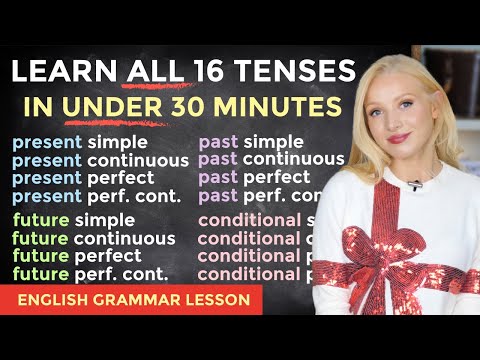
Learn ALL 16 TENSES Easily in under 30 Minutes - Present, Past, Future, Conditional +Free PDF & Quiz
English with Lucy
B1
English lessons
11:18
DO NOT say "how are you?"! Ask the question in a better way!
English with Lucy
B1
English lessons
Karaoke
9:08
You are absolutely fluent in English if you can understand these
English with Lucy
Suggested videos
B1
English lessons
Karaoke
20:12
ONE language, THREE accents - UK vs. USA vs. AUS English! (+ Free PDF)
English with Lucy
4
B1
English lessons
Karaoke
8:51
DO NOT say "you're welcome"! Respond to "thank you" PROPERLY!
English with Lucy
B1
English lessons
16:36
SELF INTRODUCTION | How to Introduce Yourself in English | Tell Me About Yourself Interview Answer
English with Lucy
B1
English lessons
Karaoke
12:51
20 Different Ways To Wish ‘Happy Birthday’ & 'Happy Anniversary' (+ Free PDF & Quiz)
English with Lucy
B1
English lessons
Karaoke
10:21
5 things to practice every day to improve your English communication skills
English with Lucy
B1
English lessons
Karaoke
29:52
Learn ALL 16 TENSES Easily in under 30 Minutes - Present, Past, Future, Conditional +Free PDF & Quiz
English with Lucy
B1
English lessons
11:18
DO NOT say "how are you?"! Ask the question in a better way!
English with Lucy
B1
English lessons
Karaoke
9:08
You are absolutely fluent in English if you can understand these
English with Lucy