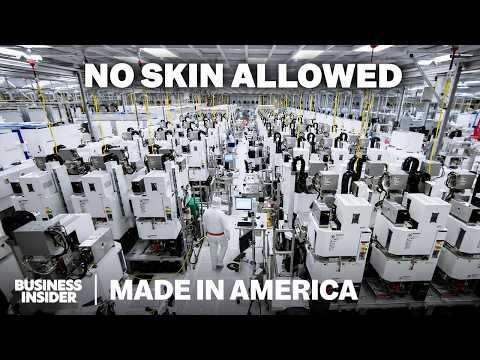
0:00 This is one of the largest denim mills in the world,
0:04 turning out 1.4 million pairs of jeans a month.
0:08 Here, thousands of workers do everything from weaving the fabric to sewing the final
0:13 pair for big American brands like Levi's.
0:17 In fact, more than 90% of denim clothing worn in the US today is
0:21 made abroad.
0:22 But, it wasn't always this way.
0:25 In the early 1900s, the US produced over a third of the world's denim.
0:30 And jeans were more than just clothing.
0:32 They were a symbol of America itself.
0:35 But now, there's only one major denim mill left here,
0:39 and it's trying to reinvent itself by selling made in America
0:43 as a premium product.
0:45 >> You're producing a piece of art.
0:47 >> And a piece of history.
0:48 >> Oh, there's no doubt about it.
0:51 >> But does anyone even care if their clothes are made in America?
0:54 I'm going to try to get to the bottom of it.
0:56 >> I think everybody likes the idea of made in America.
1:00 But, unfortunately, a lot of people just want their brand at cheapest price they
1:04 can get it.
1:06 >> So, can American mills actually compete with the massive industries abroad?
1:10 And what are they doing to stand out?
1:15 Denim was invented in 17th century France.
1:19 The name denim comes from the French de Nîmes,
1:21 which means from Nîmes.
1:23 To save money, only half the yarn was dyed,
1:26 with blue yarn woven in one direction and white going across it,
1:30 giving denim its signature look.
1:34 The fabric was cheap
1:35 and sturdy and became popular in Europe
1:37 and the US as heavy-duty workwear.
1:41 But, denim didn't become jeans until 1873, when Levi Strauss, a Bavarian immigrant,
1:47 patented a design for pants with copper rivets.
1:50 The durable jeans were advertised to workers like farmers
1:53 and mechanics and were popular with gold miners
1:56 and lumberjacks.
1:57 Celebs like James Dean and Marlon Brando helped make jeans fashionable.
2:02 Over time, they became linked with counterculture and rebellion.
2:06 By the 1960s, 95% of clothing Americans wore was made in the US.
2:11 Everything from weaving fabric to stitching the garments.
2:14 With women making up most of the workforce.
2:18 But today, just 2% of clothing sold in the US is actually made in
2:22 the US.
2:23 Now, the top three denim fabric producing countries in the world are China, India,
2:28 and Pakistan.
2:32 We visited one of Asia's largest textile manufacturers to see what US factories are
2:37 up against.
2:39 Crescent Bahuman Limited, or CBL, is located in Punjab,
2:43 in the heart of Pakistan's garment industry.
2:46 It produces more than 20 million yards of denim each year.
2:49 Far more than any denim mill in the US.
2:53 Turning it out on such a massive scale requires thousands of workers
2:56 and cutting-edge technology.
2:59 But what gives this factory a real edge is
3:02 that it also turns this denim into jeans.
3:04 Something US mills rarely do these days.
3:08 >> >> CBL sends their jeans to big brands like Levi's, Target, and American Eagle.
3:13 One big reason why garment assembly has moved to Asia is lower wages.
3:18 >> >> A textile factory worker in Pakistan, for example,
3:21 earns an average of 35,000 rupees per month, or $127.
3:26 That's 20 times less than the US.
3:29 The industry in Asia is also notorious for poor working conditions.
3:34 But CBL says it's trying to raise the bar.
3:36 Even beyond what some US companies offer.
3:39 By providing on-campus housing, transportation,
3:42 and vocational training for some of its 8,000 workers.
3:46 >> We have a full training academy on ground.
3:50 That means that whoever comes in,
3:52 we train them so they're remain employable for life whether with us
3:56 or without us.
4:07 >> This is what US mills are up against.
4:09 Highly productive one-stop shops that make fabric and the finished product.
4:16 Meanwhile, the few denim mills that have survived in the US only make fabric.
4:21 Mount Vernon Mills is one of them.
4:23 >> Our competition is not really a fabric mill in, let's say, Pakistan.
4:29 It is the entire production of a garment in Pakistan.
4:35 When garment production has migrated, the fabric production has followed.
4:41 >> John Sedevie handles the supply chain at Mount Vernon.
4:44 >> We cannot compete, even if our pricing could somehow be competitive.
4:50 We're at a at a geographic disadvantage in terms of response time.
4:54 >> So, the 180-year-old mill is trying to shake things up,
4:59 starting with its dying process.
5:01 Their plant in Georgia uses synthetic dye to color the yarn
5:04 because natural indigo is harder to acquire in such large quantities.
5:09 But the synthetic version is riskier for the environment.
5:12 If it leaks or gets dumped, the dye can pollute local waterways.
5:16 So, Mount Vernon partners with the town to treat its waste runoff.
5:19 And this gives the mill a leg up over textile factories in developing countries
5:24 that are a major source of pollution.
5:26 >> I've walked across mills in Asia where literally my shoes turned blue.
5:31 I've seen a lot of blue rivers.
5:34 >> The mill has also invested heavily in machinery so it can scale up.
5:38 Like these looms that weave the blue yarn.
5:41 One person can operate up to 19 of them.
5:44 >> You show them
5:45 that you can run these machines
5:46 and you can get extra machines.
5:48 So, the more machines you have, better money you make.
5:53 >> The machines have gotten much faster, too.
5:55 They turn out fabric at more than triple the rate they did 30 years
5:58 ago.
5:59 And that's cut down on the need for more workers.
6:02 >> We probably had close to 2,000 employees when I started working here.
6:05 Now, we've got maybe 600.
6:08 >> But some experienced folks, like Lynn Ledbetter,
6:11 have held onto their jobs because when machines mess up,
6:14 she's there to fix those mistakes.
6:18 She's an expert at tying a weaver's knot,
6:20 something a worker might do a hundred times a day >> >> every time
6:23 a thread breaks.
6:25 >> And you barely just hold it together your thumb
6:28 and hold it with this thumb
6:30 and you tie it.
6:32 >> Okay, I left it try.
6:34 >> Okay, here you go.
6:35 So, that one under there and I'll pull.
6:40 Yeah, go ahead.
6:43 I knew it was going to do that.
6:45 It didn't work.
6:49 >> >> Many of Lynn's family members have worked here, too.
6:52 It's a trend we saw across the mill.
6:54 >> My brother was a supervisor.
6:56 My sister's a smash hand.
6:58 My mom was training instructor to weave.
7:01 So, if there was a death in the family,
7:03 it was practically shutting the mill down.
7:05 Yeah.
7:07 >> She even met her husband at this plant 26 years ago.
7:10 >> Well, I tell everybody I'm the plant manager, but she's the boss.
7:13 >> Yeah, that's what he says.
7:17 >> But these days, it's hard for the US textile industry to fill jobs.
7:21 >> The challenge is always there to find people who are willing to work
7:24 a job that's labor intensive.
7:26 But again, it it's a very good honest job.
7:28 You're going to work for your money, but it's a very good job.
7:32 When I was growing up,
7:33 my dad worked 7 days a week
7:35 and the mill ran 7 days a week.
7:37 Now, we work 4 days a week, 12-hour shifts, give our employees,
7:41 you know, 3-day weekends, which helps keep retain employees.
7:45 >> And that's an issue not just in textiles, but across manufacturing.
7:50 At the end of 2025,
7:52 there were nearly half a million manufacturing job openings in the country.
7:56 And it seems like not many people want to fill them.
7:59 In one survey, 80% of Americans said the US would benefit from an increase
8:05 in factory jobs,
8:06 but only about 25% said they'd be better off working those jobs themselves.
8:13 >> They say, "Well, those, you know, people don't want those jobs anyway."
8:16 Do you think that's true?
8:18 >> When you pique their interest in the complexity, the workmanship that's required,
8:22 you'll get those people involved.
8:24 We need people to run the machinery, we need people to fix the machinery.
8:28 We also need people to develop the different types of textile products.
8:33 >> Coming up with new
8:34 and unique fabrics is one of Mount Vernon's biggest bets
8:37 as it tries to not just survive,
8:39 but even grow the business.
8:41 >> When I first came to work,
8:43 we were the king of American denim in every major retailer
8:47 and discount store in the United States with our fabrics.
8:51 Now, that's primarily out of Asia.
8:54 So, what we had to do is focus on niche markets
8:57 that required a higher degree of quality
9:00 and technical expertise.
9:02 >> That includes specialized fabrics like flame-resistant denim.
9:06 >> The type of FR treatment
9:08 that we do here is actually a chemical reaction in the fiber
9:13 that is not just a topical coating
9:15 that will wash off.
9:17 >> This type of denim is used by oil field workers and electricians,
9:21 and the mill can make a lot more money selling it.
9:24 >> The integrity and quality required in
9:27 that area is something
9:29 that people are willing to pay for.
9:31 They really don't want to wear cheap fire-resistant clothing.
9:33 >> The final test comes when lab workers expose the fabric to a flame.
9:42 The regular denim sample burns right up.
9:45 While the flame resistant sample chars and the fire burns out.
9:50 Along with going high-tech, the mill is racing to preserve low-tech,
9:54 relying on vintage machines
9:56 and techniques that give it a rare edge in a crowded market.
9:59 This loom was cutting-edge technology
10:01 when it was first invented in the mid-1900s.
10:03 >> It was as big a revolution in our industry
10:07 as the Model T was for automobiles.
10:11 There's no question about it.
10:13 >> Modern looms cut the crosswise threads after each pass, creating fringe at the edge.
10:19 On these older looms, the crosswise thread is continuous.
10:23 >> And you can see it doesn't have the fringes out to it.
10:27 >> This unique look is called selvage denim.
10:30 >> And if you get a real large selvage piece of denim,
10:34 it's price points are higher, the craftsmanship is there,
10:39 and it's you're buying a piece of history.
10:44 >> Garment makers will sew that edge into the side seam of jeans,
10:47 so that when cuffed, the selvage pokes out.
10:52 This look has become a status symbol, a sign of luxury and craftsmanship.
10:56 And people are willing to pay a pretty penny for it.
10:59 >> That's actually a market now
11:02 that some people are waiting 2 years just to get fabric.
11:07 >> Levi's sells selvage 501 jeans at nearly double the price of its original version.
11:14 And that high margin is why Mount Vernon decided to buy up these old
11:17 looms from another historic mill
11:19 that shut down.
11:21 But they were in rough shape,
11:22 and the team here is still working to get them up and running.
11:25 >> One person described it as the world's worst IKEA project.
11:30 >> So the company brought in experts.
11:32 Hector Tobaras and Jose Lopez are both originally from Colombia.
11:37 Each has about 50 years experience in textiles.
11:40 >> When he comes to the United States,
11:41 he was all the way a loom fixer.
11:45 I got lucky and I got trained in the United States.
11:47 >> Fixing looms like this is nearly a lost art.
11:50 >> We got our folks learning with them.
11:53 They are willing to pass the knowledge, so we're very lucky on that also.
11:58 >> Even with their expertise,
11:59 it'll probably take a year before all these looms are turning out selvage denim.
12:04 Meanwhile, Japan is already the leading producer of this look.
12:08 And foreign factories are never far behind on what's trending.
12:12 >> If we get what I call a hit product,
12:15 I figure we have at at the most a two to three year run
12:19 on it before it's knocked off in Asia.
12:22 >> But does anyone even care if their clothes are made in America?
12:25 I'm here in SoHo, an iconic shopping destination,
12:28 and I'm going to try to get to the bottom of it.
12:30 When you shop for clothing,
12:31 do you check the tags inside and see like what country it's made in?
12:34 >> Sometimes I do.
12:36 At some point I kind of stop
12:37 and I only realize it
12:39 when I actually kind of have it in my face.
12:41 It's really hard to find US made clothing.
12:44 If I am buying something made in the US,
12:46 it means I'm in some way contributing to the growth of a business that's
12:51 going to affect the economy.
12:52 So, I kind of would prefer if it's made here, but if it's not,
12:56 I'm not going to be angry about it.
12:58 >> I mean, if you're American,
13:00 you want the people in America to have the jobs
13:02 and opportunities and so forth,
13:04 and it should be Americans in that process if we can.
13:08 >> Is it something
13:08 that you would like pay a little extra for
13:10 if you saw it on a tag
13:12 that it was made in the US
13:13 or not really?
13:14 >> That's where we get sketchy.
13:16 I don't know.
13:16 >> I don't think the American consumer would.
13:19 I don't think they care enough, actually.
13:23 >> Still, Mount Vernon Mills has managed to survive for almost two centuries,
13:27 and the team hopes to continue this legacy right here in the American Southeast.
13:32 >> Yes, it's hard work, but it's good honest work.
13:36 Anybody can make a career out of it, and it's it's really fun.
13:42 >> To me, the Made in America tag on a product is a sign
13:47 of dedication to the American worker.
13:51 >> And no matter where you are,
13:52 pride in your craft is a sentiment everyone can relate to.
14:05 >> I've been a tester for 38 years.
14:08 >> Wow, that's a long time.
14:09 >> And you know, goodness.