TryShadowing
Shadow YouTube. Speak English.
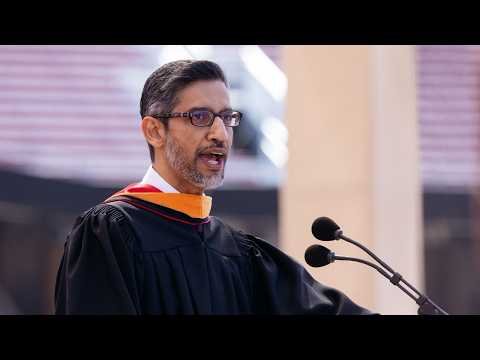
Katie Ledecky delivers Stanford's 2025 commencement speech, drawing parallels between distance swimming and life, emphasizing pacing, process, and time.
Present Perfect for life experience — used to describe activities and lessons learned over time. "I have logged a lot of miles in the water. I've spent countless hours practicing." This emphasizes duration and accumulated knowledge rather than a single past event.
Conditional structures for advice — "If/when + present, then future or imperative." "As you take the starting block and you get ready to dive in, to go the distance, I want you to remember this..." This frames hypothetical scenarios as gentle guidance.
Rhetorical questions — Questions asked not to seek answers but to invite reflection. "How do you pace your life? What does your day-to-day process look like? How do you prioritize your time?" This engages the audience and encourages self-examination without demanding direct replies.
This is Katie Ledecky's commencement address at Stanford University, where she speaks to graduating students about transitioning from their university education to the next chapter of their lives. Ledecky, an Olympic swimmer and Stanford alumna, uses her expertise in distance swimming as a metaphor for navigating life. She discusses the literal experience of swimming—the "black line on the bottom of the pool" and "keeping going when no one is watching"—before pivoting to three key life principles: pacing, process, and prioritizing time. The speech has a warm, conversational tone that feels personal while remaining broadly relatable to the graduating class.
This video is excellent for shadowing learners because Ledecky speaks at a natural, measured pace without excessive speed, making her words easy to follow and repeat. Her accent is clear American English, and her vocabulary blends everyday conversational language with inspiring, motivational phrasing. She pauses thoughtfully between ideas, giving shadowers time to process and practice without feeling rushed. The speech contains natural speech patterns—questions addressed directly to the audience, short emphatic sentences ("I've loved everything about being a Stanford grad")—that help learners internalize authentic English rhythm and intonation.
This video suits B1-level learners who have solid foundational English and want to improve their fluency through exposure to natural, moderately formal speech. Shadowing Ledecky's commencement address exposes learners to motivational, reflective English alongside practical advice. Learners will absorb colloquial expressions ("take the starting block," "make your mark"), practice stress and intonation patterns typical of inspirational speaking, and gain confidence hearing real native-speaker delivery in a high-stakes, emotionally resonant context.
take the starting block — to prepare and position oneself to begin something important or challenging; to get ready to start a significant endeavor.
keep going when no one is watching — to persist and maintain effort even without external recognition or accountability; to show discipline in private.
go the distance — to complete a full or challenging journey; to persevere through difficulty until the end.
make your mark — to make a significant impression or leave a meaningful impact on the world through one's actions and contributions.
tailwind of freedom — metaphorical support and favorable conditions that propel you forward; an advantage or backing that helps you succeed.
take joy in the pursuit — to find happiness and satisfaction in the process of working toward a goal, not just in achieving the end result.