Pronunciation scoring isn't supported on this browser — you can still record and listen back.
Ifyou'reabitconfusedwithEnglishtenses,
Translating…
Turn on Record to capture your voice and get scored
Line 1/264
Summary
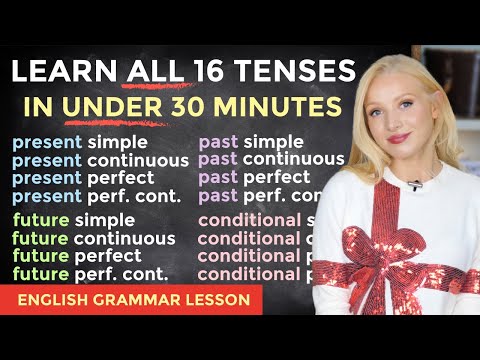
Keith from Keith Speaking Academy walks through all 12 English tenses—past, present, and future—explaining how to form and use each one with clear, everyday examples.
Simple past vs. present perfect — the simple past describes a finished action with a finished time, while the present perfect connects a past action to the present. "I worked" (finished) vs. "I have worked so far" (still relevant now).
Past continuous + simple past for interrupted actions — the past continuous sets the background scene; the simple past gives the interrupting event. "I was sitting on the sofa when suddenly I heard a strange noise."
Past perfect as the "double past" — used to show that one past action happened before another past action. "I didn't come for dinner because I'd already eaten."
Future perfect for completed future goals — formed with will + have + past participle to describe something finished before a future deadline, often with "by." "I will have finished my project by Friday."
About this video
This video is a concise, teacher-led walkthrough of all 12 English tenses, organised around three time frames (past, present, future) each with four aspects: simple, continuous, perfect, and perfect continuous. Keith uses vivid, personal examples throughout — such as "I had been living in China for 10 years when I left" and "By next year, I will have been teaching English for donkey's years" — making abstract grammar feel grounded and memorable. A particularly useful moment is when he contrasts "She will finish by Friday" (a promise) with "She will have finished by Friday" (a felt reality), showing learners how tense choice changes the force of what you say.
For shadowing practice, this video is excellent material. Keith speaks at a measured, classroom pace with clear British-accented English and natural pauses between examples, giving learners time to repeat without losing the thread. He consistently models full sentences rather than isolated words, which is exactly what shadowing practice needs. The language alternates between formal grammatical explanation and casual spoken asides ("Boom!", "Gosh!", "Got it?"), exposing learners to both registers in one session.
This video suits upper-intermediate learners (B1–B2) who already know basic tenses but want to consolidate the full system and improve fluency. Shadowers will gain confident pronunciation of auxiliary verb chains ("will have been living," "had been running"), natural sentence rhythm, and a mental map of all 12 tenses they can call on when speaking.
Idioms & expressions
by heart — to memorise something completely so you can recall it without looking. "You need to learn these irregular verbs and memorize these by heart."
brush up on — to review or practise a skill you already know but have not used recently. "If you want to brush up on your grammar… go and check out my Fluent Grammar course."
let's move on — a natural transition phrase meaning "now we will go to the next topic." Used repeatedly by Keith to shift between tenses.
for donkey's years — British idiom meaning for a very long time. "By next year, I will have been teaching English for donkey's years."
non-stop — without any pause or break. "It's been raining for 6 weeks non-stop."
Got it? — an informal check meaning "Do you understand?" used to confirm the listener has followed an explanation.