Pronunciation scoring isn't supported on this browser — you can still record and listen back.
Letmeinviteyouintomyhouse.
Translating…
Turn on Record to capture your voice and get scored
SubtitlesLine 1/120
Summary
Clinical psychologist Jenny Taitz shares three practical "stress resets" — thought defusion, half-smiling, and opposite action — to quickly regain calm in daily life.
Present continuous for habitual annoyance — using -ing forms to describe recurring frustrating behaviour, often with an implied critical tone. "Short on money, we shop online. Big deadline, we bounce between procrastination and perfectionism."
Conditional with 'can' — expressing logical possibility: if one thing is true, another follows naturally. "If you can create stress, you can also learn to reset it in minutes."
Imperative as direct instruction — Taitz repeatedly uses bare imperatives to guide the audience, making the talk feel immediate and practical. "Notice your emotion-driven urge; ask yourself if acting on it is ultimately helpful."
Nominalization — turning verbs into noun phrases to pack meaning efficiently, common in academic and professional English. "Acting exactly the way you feel when you're totally overwhelmed amplifies negativity." (the gerund phrase acting … overwhelmed becomes the subject)
About this video
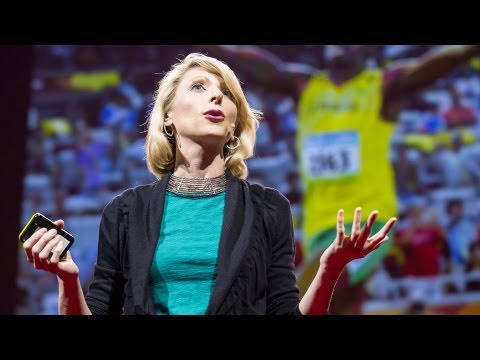
In this TED Talk, clinical psychologist Jenny Taitz opens with a vivid, almost comedic story: her husband drops a gallon of milk, cuts his hand, and rear-ends an Uber — all before breakfast. That chain reaction becomes her entry point for explaining how stress is something we co-create and spread, but also something we can interrupt. She then walks the audience through three concrete "stress resets": (1) playing with unhelpful thoughts by imagining them as blimps or singing them to a pop tune; (2) trying a half-smile to let your physiology shift your mood; and (3) acting opposite to your emotion-driven urge — for example, sending a kind text when you feel like sending a hostile one. She closes by introducing the STOP acronym (Slow down, Take a step back, Observe, Proceed mindfully) during a live Q&A.
For shadowing practice, this talk is excellent material. Taitz speaks at a clear, conversational pace — neither too fast nor too slow — with a standard American accent and very natural sentence rhythm. She uses a rich mix of storytelling, humour, rhetorical questions and direct audience interaction, giving you exposure to the kind of expressive, everyday English that is hard to find in formal lectures.
This video suits B2–C1 learners who want to build fluency in informal spoken English. You will practise stress-timed rhythm, contrastive stress ("stress doesn't just happen"), and the confident intonation of a public speaker. The psychology vocabulary is a bonus for anyone interested in mental health or self-help topics.
Idioms & expressions
spills into — spreads or overflows from one area into another. "A headache at work spills into heartache at home."
spread like the flu — to pass quickly and widely from person to person. "Stress doesn't just happen. It's something we easily co-create, then spread like the flu."
ditch hopelessness — to get rid of or abandon a feeling of hopelessness entirely. "A reset won't turn awful into awesome, but it will let you ditch hopelessness."
loosen their grip — to reduce the power or hold that something has over you. "When you play with your unhelpful thoughts, you loosen their grip."
lay low — to stay quiet, inactive, or withdrawn. "When you're depressed, you lay low."
pile on — to add more of something unwanted on top of what already exists. "Acting exactly the way you feel … amplifies negativity and piles on guilt and shame."
keep a Hope Kit — Taitz's term for a personalised collection of mood-lifting objects kept within reach. "If stress tries to convince you opposite action is impossible, keep a Hope Kit."
going 100 miles an hour — acting or reacting at an extremely fast, uncontrolled pace. "We can create so much damage if we're going 100 miles an hour."