Pronunciation scoring isn't supported on this browser — you can still record and listen back.
Forthelast20years,
Translating…
Turn on Record to capture your voice and get scored
Line 1/106
Summary
Debbie Millman shares insights from 20 years of interviews about why the joy of creative achievement fades so quickly, and why the act of making may be the true reward.
Reported speech with past tense back-shift — When recounting what interviewees said, Millman shifts tenses back: "She smiled sheepishly and stated, 'About 11 minutes.'" and "He told me you have to be really careful when you reach that peak." Notice how direct and indirect speech are woven together naturally.
Rhetorical questions for persuasion — Millman uses a string of rhetorical questions to guide the listener's thinking without expecting an answer: "Why does the feeling of creative achievement slip away almost as soon as we grasp it? Why are we in such a rush to want something more? Is it ego, ambition, addiction to attainment?"
Present simple for universal truths — Broad claims about human behaviour are stated in the present simple: "The act of making is like oxygen. When the making stops, it becomes hard to breathe." This tense choice makes the statements feel timeless and authoritative.
Concessive adverb 'albeit' — Used to acknowledge a limitation within a positive statement: "I'm learning, albeit slowly, that these moments will never, ever be enough." 'Albeit' is a formal synonym for 'even though it is' and is common in polished spoken and written English.
About this video
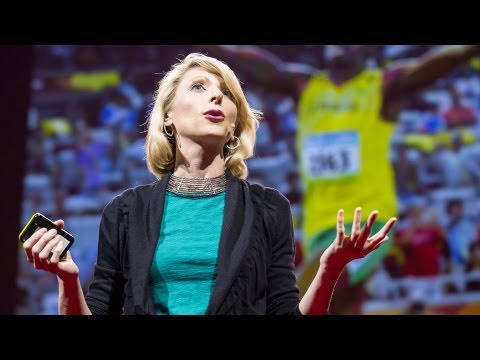
In this TED Talk, brand designer and podcaster Debbie Millman explores a phenomenon she first noticed when a famous painter told her the pride from a career-defining exhibition lasted exactly "about 11 minutes." Drawing on hundreds of interviews from her podcast Design Matters and a Proustian questionnaire she ran in PRINT magazine, Millman reveals that the euphoria of creative accomplishment — publishing a book, winning an award, performing on stage — almost universally dissolves within hours or days. A striking moment comes when she quotes rock legend David Lee Roth warning her that reaching the peak of the tallest mountain means it is "always cold, you're often alone, and there's only one direction to go," a metaphor that crystallises her whole argument.
This talk is excellent for shadowing because Millman speaks at a measured, deliberate pace with clear American English pronunciation. She uses rich, varied vocabulary alongside conversational asides and even pauses for audience laughter, giving you practice with the natural rhythms of a polished public speech — not a scripted read-aloud.
The talk suits upper-intermediate to advanced learners (B2–C1). You will gain exposure to reflective, first-person narrative speech, abstract philosophical language about creativity, and persuasive rhetorical devices such as triads ("create, shape, build, imagine, express") and rhetorical questions. It is especially rewarding for learners who want to sound natural and thoughtful when discussing ideas in English.
Idioms & expressions
not by a long shot — not at all; used to strongly emphasise that something is far from being the case: "She's not the only one whose achievements feel ephemeral and fleeting. Not by a long shot."
fake it until you make it — pretend to have confidence or skill until you genuinely develop it: "If we haven't yet reached mastery, we're told we have to fake it until we make it."
at play — influencing or operating in a situation: "I've come to believe that something else is at play."
answering a calling — responding to a deep inner drive or vocation, as if called by a higher purpose: "I see people answering a calling."
heed the calling — listen and respond to a strong inner or moral urge: "Heed the calling. Continue to make things."
glorify the grind — celebrate and romanticise working extremely hard without rest: "We glorify the grind, and we equate visibility with value."
consumed with — completely preoccupied or obsessed by something: "I became consumed with the question of why."
right then and there — immediately at that exact moment: "It occurred to me right then and there that I didn't want to peak until the day before I die."