Pronunciation scoring isn't supported on this browser — you can still record and listen back.
Okay.
Translating…
Turn on Record to capture your voice and get scored
Line 1/279
Summary
A British English teacher breaks down travel vocabulary for IELTS learners, clarifying the differences between trip, journey, tour, outing, excursion, and staycation, plus word forms of "travel".
Uncountable vs. countable noun — "travel" is uncountable (no article, no plural a travel), but can appear as a modifier in a noun phrase. "Do you have any travel plans this summer?"
Gerund as subject (noun phrase) — When a verb form acts as the subject of a sentence, English prefers the -ING (gerund) over the to-infinitive. "Travelling is my biggest hobby."
Plural of an uncountable noun for special meaning — Some uncountable nouns can be used in the plural to express a different, specific meaning. "Tell me about your travels around Europe." (= a series of journeys)
Verb + preposition collocations with transport — The preposition changes depending on mode of transport: "by" for vehicles (by bus, by plane) but "on foot" for walking — a fixed expression learners must memorise. "I travel on foot."
About this video
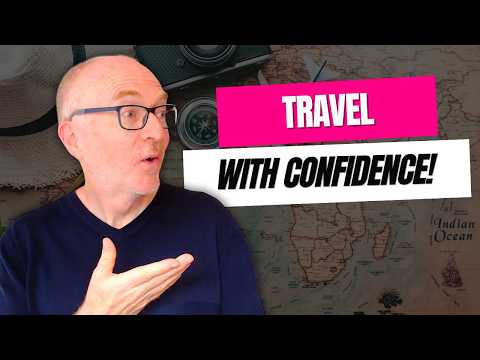
This live-lesson video focuses entirely on travel vocabulary for IELTS preparation, taught by a British teacher on the English Speaking Success channel. The teacher works through the word family of "travel" in careful detail — explaining why you cannot say "a travel" (uncountable noun), when "travels" as a plural is acceptable (meaning a series of journeys, as in Gulliver's Travels), and how the gerund "travelling" functions as a noun phrase at the start of a sentence. A particularly memorable moment is the teacher's mock outrage at the phrase "travel on foot" — pointing out that walking uses two feet, yet English insists on the singular — which is a clever hook to help learners remember the fixed collocation.
For shadowing practice, the video is excellent material. The teacher speaks at a naturally measured pace, repeating key contrasts multiple times (trip vs. journey vs. tour vs. outing), which gives learners multiple chances to rehearse the same phrases. The accent is clear standard British English (RP-adjacent), and the register is informal but precise — exactly the kind of spoken English IELTS candidates need to reproduce in the Speaking test.
The video suits B2 learners targeting IELTS Band 6–7. Shadowers will gain confident control over the travel vocabulary set, absorb natural collocations like "go on a trip / tour / outing," and pick up the key grammar distinction between uncountable "travel" and countable "journey" or "trip."
Idioms & expressions
have itchy feet — to have a strong desire or urge to travel; to feel restless and want to go somewhere new
hop on hop off — a type of sightseeing bus service where passengers can board and exit at any stop along a fixed route
go on a trip — to take a short leisure journey, travelling to a place and returning; used for holidays or short outings
go on a tour — to visit a place or attraction in an organised, guided way, typically moving through different parts of it
travel on foot — a fixed idiomatic expression meaning to travel by walking (notably, not "by foot")
go for a walk / go hiking — fixed natural expressions for recreational walking; contrasted in the video with the incorrect forms "go for a walking / hiking"