Pronunciation scoring isn't supported on this browser — you can still record and listen back.
IwasonemonthoutfrommyOlympicraceinRio,
Translating…
Turn on Record to capture your voice and get scored
Line 1/108
Summary
Olympic runner Alexi Pappas shares her coach's "rule of thirds" — feeling good, okay, and crappy equally — as a mindset for chasing dreams and embracing bad days.
Key vocabulary
splitsworkoutratiopotentialelevationultramarathonsustainableperspectivevoyagernational record
Grammar notes
Rhetorical questions for emotional effect — The speaker asks questions she answers herself to draw the listener in. "What am I going to do? Am I good enough?" This is common in spoken persuasive English and great for practising rising intonation.
Modal verb "might" for tentative advice — "Might" is used to soften suggestions, making them sound measured rather than absolute. "You might need to dial things up" / "you might need to actually dial things back."
Conditional zero/first hybrid for general truths — Pappas states the rule as a timeless principle using "if + present, then present/imperative." "If you're within this ratio, then the bad days aren't bad."
Past simple narrative sequencing — The talk is structured as a personal story told entirely in the past simple, with clear time markers. "I got back on the track, and I finished the workout… And then I went to the Olympics, and I broke a national record."
About this video
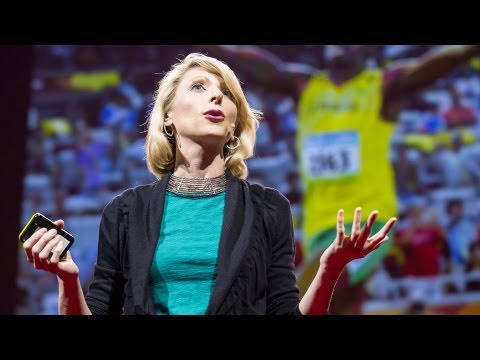
In this short TED Talk, Olympic runner and filmmaker Alexi Pappas describes a pivotal training moment one month before the 2016 Rio Olympics, when she broke down crying in lane one after failing to hit her splits. Her coach — himself a former Olympian — responded not with technique advice but with a single command: "Take your watch off." He then introduced her to the rule of thirds: when chasing any hard goal, you are supposed to feel good one third of the time, okay one third, and crappy one third. Pappas goes on to apply this principle to writing her book Bravey, directing three films, and even completing the brutal 100-mile Leadville ultramarathon through the Rocky Mountains, where she walked the final 40 miles through the night but never quit.
For shadowing practice, this talk is excellent material. Pappas speaks at a natural but very clear conversational pace, with a warm, informal American accent and frequent rhetorical questions ("What am I going to do? Am I good enough?"). The language alternates between punchy short sentences and longer narrative stretches, giving learners practice with both rapid staccato delivery and flowing storytelling intonation. Emotion and emphasis are well-marked in her voice, making it easy to mimic natural stress patterns.
This video suits B2–C1 learners who want to practise motivational and reflective English. Listeners will gain confidence with informal spoken grammar, emotionally expressive speech rhythm, and vocabulary around achievement, perseverance, and self-coaching.
Idioms & expressions
hit my splits — to achieve the target pace/time for sections of a training run; here used negatively ("couldn't hit my splits")
dial things up — to increase effort, intensity, or difficulty
dial things back — to reduce effort or intensity; the opposite of "dial things up"
hanging on — barely managing to continue; surviving a difficult situation with great difficulty ("I was barely hanging on")
stay on your own team — to keep believing in and supporting yourself, especially when things are hard
let go of control — to stop trying to control every outcome and trust the process instead
a third of the time — used as a fractional expression to describe how often something should occur; key to the "rule of thirds" concept
under the sun and under the moon — an emphatic idiom meaning at all hours and in every possible way ("I felt every feeling under the sun and under the moon")