Pronunciation scoring isn't supported on this browser — you can still record and listen back.
>>Afewyearsago,whenIwasvisitingfamily,
Translating…
Turn on Record to capture your voice and get scored
Line 1/234
Summary
Evolutionary biologist Kaleda Denton explains how mathematical models of conformity and anti-conformity help us understand social trends, from fashion cycles to group polarization.
Conditional sentences (Type 2 / hypothetical) — Used to describe model scenarios and self-reflection. > "If you knew that you had a tendency to conform to these people, would you want the answers to any of these questions to be different?"
Passive voice for research findings — Denton uses the passive to report scientific results without naming a specific agent. > "Conformity has even begun to be detected in large language models like ChatGPT."
Modal verbs for hedging (might, can, could) — Academic speakers use modals to avoid overstatement and signal uncertainty. > "Strong conformity in one group could cause a trait to grow popular in both groups."
Discourse markers for contrast and concession — Words like but, instead, counterintuitively, and in other words organize the argument and signal shifts in logic. > "Counterintuitively, conformity might not maintain an in-group out-group difference."
About this video
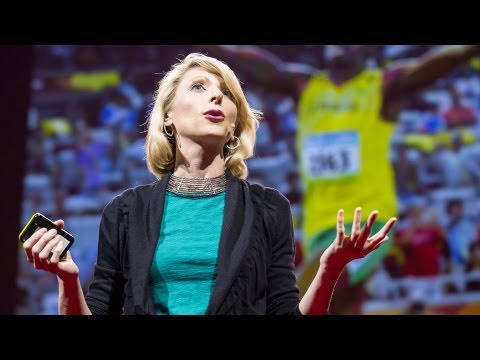
In this TEDxNewEngland talk, evolutionary biologist Kaleda Denton uses a relatable opening — her nephew telling her that skinny jeans are "very millennial" — to launch into a rigorous but accessible exploration of how conformity and anti-conformity drive social trends. She walks through a classic 1985 mathematical model of binary choice (iPhone vs. Android), explains what "disproportionate tendency to copy the majority" really means, and then shares her own PhD discovery: that when individuals observe five or more people rather than three, anti-conformist populations don't stabilize — they cycle between states, just like baggy jeans replacing skinny jeans replacing baggy jeans. She also presents a counterintuitive finding about subgroups: strong conformity in one subgroup can actually erase differences between groups rather than reinforce them.
For shadowing practice, this talk is excellent material. Denton speaks at a measured, presentation-friendly pace with clear American English pronunciation and deliberate pausing between ideas. She frequently uses rhetorical questions ("Think about it. Last time you bought new clothes…"), conditional sentences, and academic hedging language — all highly useful patterns for learners to internalize. The vocabulary is a blend of everyday speech and scientific terminology, giving learners exposure to both registers in a single, coherent context.
This video suits upper-intermediate to advanced learners (B2–C1). Shadowers will gain confidence with academic spoken English, conditional structures, and the kind of precise, organized discourse typical of TED-style presentations — skills directly transferable to professional and academic speaking situations.
Idioms & expressions
fitting in — conforming to the norms or style of a group so you are accepted
standing out — being noticeably different from the people around you
picked up on — noticed or detected something that others may have missed ("nobody had picked up on it since 1985")
scaled up — increased or expanded from a small level to a much larger one ("scale this up to the population level")
make sense of — understand or find meaning in something confusing ("we often can't make sense of what's happening")
all models are wrong, but some are useful — a famous quote used here to mean that simplified models never perfectly reflect reality, but they can still provide valuable insight
venture into — begin exploring a new area of activity or study ("the beginning of my seven-year-long venture into modeling conformity")