Pronunciation scoring isn't supported on this browser — you can still record and listen back.
Theotherdayinmylivecallwithmymembers,
Translating…
Turn on Record to capture your voice and get scored
Line 1/291
Summary
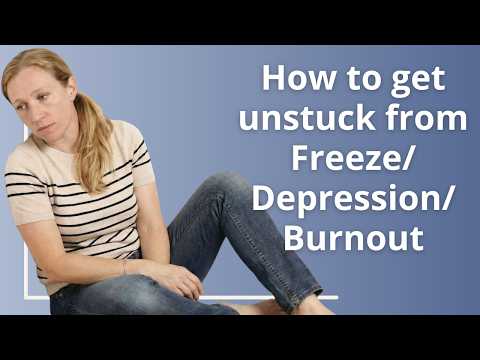
A therapy video explaining why people experience emotional numbness and dissociation, and five practical techniques to help them reconnect with their feelings.
Passive voice for protective description — The speaker avoids blame by saying "you were learned to shut them off" or "numbness was a coping skill that we learned," placing the focus on the response rather than the person. Example: "Numbing is a protective response, and humans do it, too."
Conditional structures (would + verb) — Used to explore hypothetical emotional states and responses. Example: "If an observer of your life were to guess what might they say instigated it" and "If showing emotions wasn't safe as a child, you may have learned to shut them off."
Imperative (direct instruction) — The five techniques are delivered as commands to engage the listener actively. Example: "Ask yourself, 'Where do I feel numbness in my body?'" and "Notice that here in this moment, I am safe enough."
About this video
This video addresses a deeply practical question: how do you process emotions when you feel completely blank or numb? The therapist walks through a real scenario from a member who experienced trauma and lost the ability to feel anything—emotionally or physically. Rather than treating numbness as a character flaw, the video frames it as your nervous system's protective survival response, explaining how the freeze-or-shutdown state protects the body just as it does in animals confronting danger.
The content is ideal for shadowing because it combines clear, conversational explanation with natural pacing. The speaker uses concrete metaphors (animals freezing to survive, the "polyvagal ladder") and repeated key phrases ("It's important to remember…," "Thank you, numbness, for trying to protect me") that anchor listening and repetition. Medical and psychological terminology is defined accessibly without jargon overload.
This suits intermediate learners (B1) who can follow explanations of abstract emotional concepts and want to improve speaking around mental health or personal development topics. The five techniques—grounding with senses, movement, restoring safety, dialoguing with numbness, and dramatizing emotions—are practical and often repeated, building natural recall and fluency. Learners will gain both vocabulary and the rhythmic patterns of therapeutic language.
Idioms & expressions
It's the best you can do — Making the most sensible choice given your circumstances at the time. Example: "Now, as a child, it's the best you can do."
Morphs into — gradually transforms or develops into something different. Example: "So, what started as protection morphs into alcoholism or workaholism or screen addiction."
Bang, there it is — direct, sudden recognition of the answer or problem. Example: "'I'm struggling with not being able to connect with my body where I'm just numb emotionally and physically.' Like boom, there it is."
Go numb — enter a state of emotional or physical unresponsiveness. Example: "Numbing is often a response to overwhelming stress or trauma."
Add stress to the system — increase pressure or strain on a person's mind or body. Example: "Trying to force it is actually adding stress to the system."
Move back up the ladder — return to a better emotional or physiological state. Example: "It helps us move back up the polyvagal ladder into a sense of safety."
Step aside — move out of the way, either literally or figuratively (here, cease blocking). Example: "Would you be willing to step aside so that I can see what's behind you?"
Made it all the way to the end — completed something difficult or lengthy. Example: "And if you've made it all the way to the end of this video, could you please leave a comment."