0:00 The other day in my live call with my members,
0:02 a member asked this question.
0:04 "How do I recognize my emotions when I feel blank?
0:08 I don't see where I fit on the emotions wheel."
0:10 Now, most people know
0:12 that naming an emotion is the first step to working through it.
0:16 But what if you just feel empty?
0:19 Like you just can't cry
0:21 or maybe you feel flat
0:23 or numb or shut down
0:24 or even dead inside.
0:26 Now, this can be confusing and scary,
0:28 but it's actually your body's natural survival response.
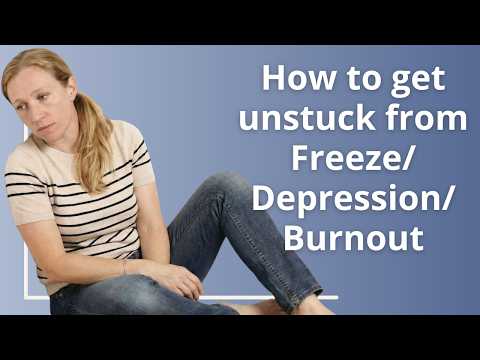
0:31 So, in this video, we'll talk about why people feel numb, and more importantly,
0:34 five things you can do to help you start feeling again.
0:45 Emotional numbness is a common experience, and here's what it can look like.
0:48 Feeling flat both physically and emotionally.
0:51 Losing motivation or interest in things that once brought you joy. not feeling happiness,
0:56 but not even feeling sadness either.
0:58 Feeling detached, like you're watching your life happen from the outside.
1:02 Now, if you relate to any of that, I would say you're not broken.
1:06 You're experiencing a nervous system response.
1:08 But a response to what?
1:09 Like, why do we go numb?
1:11 Now, I had my guesses about why my member was feeling this way.
1:14 When I saw that he had submitted a second question,
1:17 this is what he said,
1:18 "I experienced a traumatic event
1:20 that has turned my life upside down the last four
1:23 or five months.
1:24 I'm struggling with not being able to connect with my body where I'm just
1:28 numb emotionally and physically."
1:31 Like boom, there it is.
1:33 Numbness is often a response to overwhelming stress or trauma.
1:37 It's one of the hallmark symptoms of PTSD.
1:39 So, let's talk about the stages our nervous system goes through
1:42 when it experiences a threat.
1:44 When your nervous system senses danger,
1:45 it goes through three steps to keep you safe.
1:48 First, it scans for help to support or protect you.
1:51 Then, it can activate the fight or flight.
1:54 But if you can't fight off the problem
1:56 or escape your attacker
1:57 or if you've tried to overcome the problem
1:59 so many times and it just never seems to work,
2:02 your body may go into the third state.
2:04 This is the dorsal vagal response, also known as freeze or shutdown.
2:08 That's when people describe feeling numb, detached, spaced out, or empty.
2:13 Now, animals do this all the time.
2:14 Freezing and going numb protects them from being seen, from making noise,
2:18 from feeling pain, and that can help them survive a threat from a bigger,
2:23 stronger aggressor.
2:24 Numbing is a protective response, and humans do it, too.
2:27 It's important to remember going numb isn't something you consciously chose to do.
2:32 Your nervous system made the decision.
2:34 So, why do people go numb?
2:35 There's a few common reasons.
2:38 Overwhelm or trauma is one of the biggest ones.
2:40 When emotions are too big, the brain protects you by disconnecting.
2:45 Grief or loss.
2:45 People often expect grief to show up
2:47 as a lot of tears
2:48 or sadness or anger.
2:50 But it's also very,
2:51 very common that they're just feeling flat or like they're not feeling anything.
2:58 Chronic stress and burnout.
2:59 Constant stress floods your body with stress hormones
3:03 and eventually this depletes your ability to get activated.
3:07 Some people call this adrenal fatigue,
3:09 but really you've just depleted all your resources
3:12 and your nervous system is tired of trying,
3:15 so it numbs out.
3:16 Depression is another common cause.
3:18 This often brings flatness where both joy and sadness feel out of reach.
3:22 Also, going numb is a learned survival strategy.
3:25 If showing emotions wasn't safe as a child,
3:27 you may have learned to shut them off.
3:29 Now, more on that last one in a moment,
3:31 but I do need to add
3:31 that sometimes numbness is linked to biological
3:34 or medical issues,
3:35 including mental health conditions like schizophrenia, borderline, or bipolar disorder.
3:39 Exhaustion and chronic illness can also leave you feeling flat,
3:43 and so can medication side effects.
3:45 So, if you suspect that that's the case, it's worth talking with a doctor.
3:49 But for many, numbness is the nervous system's way of saying,
3:52 "That was too much.
3:53 I'm protecting you now."
3:55 Okay, so back to learned habits.
3:56 Sometimes numbness and dissociation was a coping skill
3:59 that we learned as kids to deal with a situation
4:02 that was scary or painful
4:03 and we couldn't leave.
4:04 Maybe there was abuse you couldn't escape.
4:06 Or if your parent constantly criticized you
4:09 and nothing you did was ever good enough,
4:10 your 12-year-old self probably responded with, "Fine, I don't care."
4:15 Now, over time, pretending not to care became real,
4:18 and numbing turned into a habit.
4:20 We learned to numb ourselves to escape some of that pain.
4:23 And then numbing becomes a habitual defense mechanism.
4:26 Now, as a child, it's the best you can do.
4:28 But as an adult,
4:29 you come to depend on this skill long after danger is gone.
4:32 So, what started as protection morphs into alcoholism
4:36 or workaholism or screen addiction
4:38 or dissociation.
4:40 So, as we rely on it more and more,
4:41 it becomes less and less functional.
4:43 The good news is that if you learned it, you can unlearn it.
4:46 So, let's talk about how.
4:48 Now, when we feel numb, we often try two things that backfire.
4:52 Either we try to force ourselves to feel something
4:55 or we try to think our way out of it.
4:57 Trying to force it is actually adding stress to the system.
5:00 It pushes us further into the dorsal vagal response.
5:03 And trying to think our way out of it is a form of intellectualization.
5:07 It's another subtle attempt to avoid our actual feelings by getting up in our
5:11 heads.
5:12 So here's five things that actually work.
5:14 The first step isn't to fight numbness,
5:16 but to notice it with curiosity and kindness.
5:18 So instead of demanding that you feel something,
5:22 approach numbness like a scientist exploring something new.
5:25 Ask yourself, "Where do I feel numbness in my body?"
5:29 What does numbness feel like?
5:31 Now, this came up in an interview I did with mindfulness expert Thomas McConkie
5:35 and I like how he explains it.
5:37 To learn to attune to that kind of a numbness, a nothingness,
5:42 like I don't feel anything.
5:44 Not feeling anything is another kind of feeling.
5:47 And if we learn to stay with I don't really feel anything,
5:50 we're surprised that wow,
5:51 there are like 20 layers to that I don't really feel anything,
5:56 we get deeper and deeper into our actual experience and it yields amazing insight.
6:02 Remind yourself that today is a beautiful day to feel whatever you're feeling
6:07 or not feeling right now.
6:09 It's a day to allow yourself to be where you're at.
6:13 Not forcing it, but just being present to your experience right now.
6:16 And this can tell your nervous system that you are capable.
6:18 It can nudge you up the ladder toward internal safety.
6:22 Now, because numbness is a nervous system state, not a thinking problem,
6:25 we need body-based approaches.
6:27 So, the way through numbness isn't to force yourself to just feel,
6:31 but to gently reawaken your nervous system.
6:33 So, here's a few things you could try.
6:35 Grounding with your senses.
6:36 I think a lot of people are familiar with this,
6:38 but you touch something with texture.
6:40 You notice a color around you.
6:43 Or you put on some music and you listen to it.
6:45 Your senses can help you re-enter to the present moment.
6:48 Now, Peter Levine teaches a simple exercise in his book, Healing Trauma.
6:52 So, you go into the shower
6:53 and you allow the water to hit various parts of your body
6:56 and let yourself mindfully feel it.
6:58 It might hit your hand
7:00 and you look at it
7:02 and you notice how it feels to have the water hit your hand,
7:05 then have it hit your arm
7:06 and you allow it
7:07 and notice how it feels.
7:09 So, we can practice connecting with our emotions through our body's sensations.
7:14 Okay.
7:14 Next, movement is medicine.
7:16 So, try walking, stretching, or shaking out your hands.
7:20 Research shows that exercise is one of the most powerful treatments for depression.
7:24 It helps us move back up the polyvagal ladder into a sense of safety.
7:28 Okay.
7:29 Number three, restore your sense of safety.
7:32 When we feel safe, our nervous system naturally climbs back out of shutdown.
7:36 So, look around the room, move your head, move your eyes.
7:42 Notice that here in this moment, I am safe enough.
7:46 Remind yourself, I have people who will support me.
7:49 One of the most direct ways to restore a sense of safety is being
7:51 in physical contact or eye contact with a caring person
7:55 or even a pet.
7:56 You don't even have to talk about it, though that's not terrible either.
8:00 You could do some of the restoring safety exercises from my free Grounding Skills
8:03 Course,
8:04 and I'll put a link in the description.
8:05 You could do a safe place visualization.
8:08 You could turn on your safe playlist
8:10 or pull out your safe cues sensory kit.
8:13 If you're exhausted, burnt out, or overwhelmed,
8:14 you probably need a little break to create safety from whatever is draining you.
8:19 So ask yourself, what can you do to get some rest?
8:23 Safety isn't just about your environment.
8:25 It's the message your nervous system receives that says, "I can handle this."
8:30 Okay.
8:30 Number four, ask what's behind the numbness.
8:33 So behind numbness, there's often a huge emotion.
8:35 Numb is a protector.
8:36 It's desperately trying to protect you from a feeling.
8:39 If we imagine this protector, it might be saying,
8:41 "I'm afraid little Emma can't handle feeling
8:44 so much sadness or grief
8:46 or anger or pain."
8:48 So, how can you respond to your protector part?
8:50 Can you show compassion to your numbness?
8:53 Maybe speak to it.
8:54 Thank you, numbness, for trying to protect me.
8:56 Ask your numbness, "What are you trying to protect me from?"
8:59 Or ask it, "What would you like to tell me?"
9:02 You could reassure your numbness part from a place of self.
9:05 You could say, "I'm not a little kid anymore.
9:07 Thank you so much for what you, numbness,
9:10 have been trying to do to protect me."
9:12 You could also ask it like,
9:14 "Would you be willing to step aside
9:15 so that I can see what's behind you?"
9:18 Now, sometimes numbness may be willing to step aside
9:20 and let you glimpse what's underneath.
9:22 Other times, it won't, and that's okay.
9:24 And again, this work might be best done with a therapist.
9:28 When numbing and dissociation become really chronic,
9:31 removing our internal defense mechanisms can sometimes leave us overwhelmed with big traumas
9:36 that we'll do a lot better with support
9:39 as we work through them.
9:41 Okay, number five, act it out.
9:43 When you're numb or dissociated,
9:44 it can be really helpful to dramatize the emotion that you're not feeling.
9:48 Now, I know this sounds maybe a little counterintuitive,
9:51 but like hang with me here.
9:53 There are a few steps to this.
9:55 So even if you can't feel or name an emotion,
9:57 you probably know deep down what's behind your numbness.
10:00 If an observer of your life were to guess what might they say instigated
10:04 it.
10:05 You don't have to force an answer like forcing it pushes us down into
10:09 the dorsal vagal response,
10:11 but a guess might be helpful for this next step.
10:14 So, for example, if someone close to you recently passed away
10:17 and you're feeling numb,
10:18 let's guess that under the numbness, you're feeling grief or anger around that.
10:23 So now imagine how someone who lost a loved one would feel
10:26 and describe that in writing.
10:28 And I do mean like describe,
10:29 like don't just say this person would feel sad.
10:32 Write it like a character scene.
10:33 Describe the sobs, the inability to speak, the stomach ache, squeezing the eyes,
10:38 hugging a pillow, so on so on.
10:40 You could watch a video
10:41 or read a story of someone going through the same kind of trauma
10:45 that you've been through.
10:46 Okay.
10:47 So, this last part like
10:48 that I just described might sound
10:50 so awkward that you don't want to try it.
10:52 But if you feel safe enough and resourced enough,
10:55 like I do encourage you to try to act out those emotions you imagined.
10:59 You could yell or shake or fake some crying.
11:02 You could pretend you're an actor on stage,
11:04 feeling a character's emotions and then act them out.
11:07 Okay, so there's five options for working through emotional numbness.
11:11 Recognize that it's your body's protective response to overwhelming feelings.
11:15 Treat numbness with curiosity and compassion.
11:18 Restore your sense of safety.
11:19 Connect with your body.
11:21 And with movement, dramatize the emotion you're missing.
11:24 With each of these five ways to respond to numbness or dissociation,
11:28 you're recognizing that your nervous system is just trying to protect you from something.
11:33 And if you feel supported and well resourced,
11:35 you can figure out what
11:36 that scary something is
11:38 and start to heal it by responding to it in healthy ways
11:41 that counteract the numbness.
11:43 Okay.
11:43 I hope this has been helpful
11:45 and even helpful for you
11:46 that you can restore your ability to feel sensation in your body
11:50 and experience a wide range of emotions.
11:53 You don't have to force it at all, but by taking small steps,
11:57 you can work through it.
11:59 I'm working on a whole series about embodiment and emotional regulation after trauma.
12:03 So, if this resonated, you can learn more by checking out that playlist.
12:07 Or if you're ready to dive deep into the skills to improve your mental
12:10 health,
12:10 check out my membership.
12:11 I've got 10 courses on everything from how to regulate your nervous system to
12:14 how to process emotions
12:15 and work through trauma. 98% of people who took my courses said
12:19 that it helped them improve their mental health.
12:21 Check it out.
12:21 Links in the description.
12:23 And if you've made it all the way to the end of this video,
12:25 could you please leave a comment or a thumbs up?
12:28 This tells the algorithm to show this video to more people who could benefit
12:32 from it.
12:33 Okay.
12:33 Thank you so much for being here and please take care.