Pronunciation scoring isn't supported on this browser — you can still record and listen back.
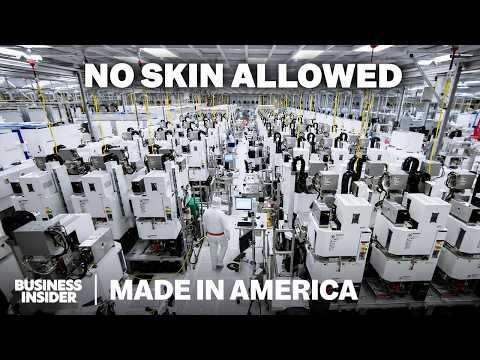
Thisisoneofthelargestdenimmillsintheworld,
Translating…
Turn on Record to capture your voice and get scored
Line 1/262
Summary
A look at how one American denim mill is surviving by competing with massive overseas factories, focusing on quality and heritage techniques like selvage denim production.
Comparative structures with 'more' and 'far' — used to emphasize scale differences — "Far more than any denim mill in the US" and "Produces more than 20 million yards of denim each year."
Passive voice for manufacturing processes — emphasizes the product rather than the actor: "The fabric was cheap and sturdy and became popular in Europe," and "These jeans were advertised to workers like farmers and mechanics."
Present perfect with 'has/have managed' and 'has/have survived' — describes ongoing achievement against odds: "Mount Vernon Mills has managed to survive for almost two centuries" and "the few denim mills that have survived in the US."
About this video
This Business Insider documentary explores Mount Vernon Mills, one of the last major denim producers in the United States, as it fights to survive against cheaper Asian manufacturers that produce over 90% of the world's denim. The video traces denim's history from 17th-century France through its American golden age in the 1960s—when 95% of US clothing was domestically made—to today's reality where only 2% is. A turning point comes when viewers visit Pakistan's Crescent Bahuman Limited factory, where workers earn $127 a month (20 times less than US wages) and the factory handles both fabric production and garment assembly in one location.
Mount Vernon's strategy is compelling: they're positioning themselves as a premium producer rather than competing on price. The mill invests in specialized products like flame-resistant denim for oil workers, partners with the town to treat toxic dye runoff (a problem factories in Asia ignore), and is betting heavily on reviving selvage denim—a vintage loom technique that commands double the price because the selvage edge becomes a luxury status symbol when visible on cuffed jeans. Lynn Ledbetter, a skilled veteran worker, represents the human heart of this strategy: she ties weaver's knots by hand nearly 100 times daily, knowledge that machines cannot replicate.
The video suits B1 learners well because the pace is measured, the narrator speaks clearly with no heavy accent, and the language mixes accessible conversational English (worker interviews) with technical vocabulary naturally explained in context. Learners will gain exposure to manufacturing terminology, comparative structures ("Far more than any denim mill"), and authentic workplace dialogue—plus insight into real economic choices ordinary people face.
Idioms & expressions
shake things up — make significant changes or improvements to a situation; here, Mount Vernon's efforts to innovate: "the 180-year-old mill is trying to shake things up, starting with its dying process."
fill jobs — find workers willing to work in available positions: "these days, it's hard for the US textile industry to fill jobs."
hold onto your job — keep your employment despite difficult circumstances: "some experienced folks, like Lynn Ledbetter, have held onto their jobs because when machines mess up, she's there to fix those mistakes."
get a leg up — gain a competitive advantage: "this gives the mill a leg up over textile factories in developing countries."
knocked off — copied or imitated (usually quickly and cheaply): "we have at most a two to three year run on it before it's knocked off in Asia."
pique someone's interest — spark or attract someone's curiosity: "When you pique their interest in the complexity, the workmanship that's required, you'll get those people involved."